


Fuel Distribution Management Guide
From Depot to Dispenser: Mastering Fuel Distribution in High-Performance Networks
Where Every Litre in Motion Determines Profitability
Fuel distribution is one of the most operationally intense and financially sensitive functions in downstream oil and gas.
Once product leaves the terminal or depot, it enters a dynamic environment where timing, coordination, accuracy, and control must all align perfectly. Tankers move across long distances, deliveries are executed across multiple locations, and inventory shifts continuously between depots, stations, and customers.
At this stage, the margin for error becomes extremely narrow.
A delayed delivery can disrupt retail sales.
A routing inefficiency increases transport costs.
A small variance in quantity, multiplied across hundreds of trips, can translate into significant revenue loss.
In many operations, these challenges are not immediately visible. Distribution is often managed through a combination of manual coordination, isolated tracking tools, and delayed reconciliation processes. By the time discrepancies are identified, the operational and financial impact has already occurred.
Industry benchmarks indicate that inefficiencies in fuel distribution alone can account for 15–25% of avoidable operational costs, while untracked losses during transit and delivery can range between 2–4% of total product volume annually.
And yet, distribution is frequently treated as a logistics function rather than what it truly is: A real-time operational control system that directly impacts cost, revenue, and customer satisfaction.
In modern downstream operations, success is not by how much fuel you move but by how precisely you control every litre in motion.
Understanding Fuel Distribution: More Than Just Logistics
A High-Precision System Where Movement, Data, and Control Must Align
Fuel distribution is often viewed as a straightforward process; load, transport, deliver.
In reality, it is one of the most complex and tightly interdependent functions in downstream operations. Every movement of fuel triggers changes across inventory, finance, customer commitments, and operational planning.
It is not just about moving product.
It is about ensuring that every litre moved is tracked, validated, accounted for, and financially aligned in real time.
1. Distribution is a Continuous Inventory Transformation Process
Every dispatch immediately alters inventory positions across the network.
- Depot stock decreases
- In-transit stock is created
- Receiving location stock is expected to increase
Without real-time synchronization, these transitions create gaps. In many operations, inventory updates lag behind physical movement by 4–24 hours, leading to planning inaccuracies and stock misalignment.
Organizations with synchronized distribution systems can improve inventory accuracy by up to 50–60%, reducing both stockouts and excess holding.
2. In-Transit Visibility is as Critical as Static Inventory
Fuel in motion is often the least visible and most vulnerable portion of inventory.
Without real-time tracking:
- Tanker locations are estimated, not known
- Delivery timelines are uncertain
- Potential diversions or delays go undetected
Industry data shows that lack of in-transit visibility can contribute to 5–10% inefficiency in delivery execution, including delays, route deviations, and unplanned stoppages.
3. Distribution Directly Impacts Revenue Realization
Revenue is not realized at dispatch, it is realized at accurate and validated delivery.
If delivery data is delayed or inaccurate:
- Invoicing is delayed
- Cash flow cycles are extended
- Discrepancies arise between delivered and billed quantities
Manual delivery confirmation processes can delay revenue recognition by up to 24–72 hours, affecting financial performance and reporting accuracy.
Digitized validation significantly accelerates billing cycles and improves revenue accuracy.
4. Routing Efficiency Determines Cost Structure
Transport is one of the largest cost components in fuel distribution.
Inefficient routing leads to:
- Increased fuel consumption
- Higher driver hours
- More trips than necessary
Studies indicate that poor route planning can inflate transport costs by 10–20%, especially in multi-destination delivery networks.
Optimized routing and load planning can reduce these costs while improving delivery timelines.
5. Distribution is a Multi-Party Coordination Challenge
A single delivery involves multiple stakeholders:
- Dispatch teams
- Drivers
- Depot operators
- Receiving stations or customers
- Finance teams
Breakdowns in coordination can result in:
- Missed delivery windows
- Incorrect quantities delivered
- Documentation inconsistencies
In fragmented environments, coordination inefficiencies can reduce overall distribution productivity by up to 25–30%.
Effective distribution requires seamless synchronization across all parties involved.
6. Reconciliation is Not a Back-End Task
Reconciliation is often treated as a post-distribution activity.
In reality, it is central to ensuring:
- Quantity accuracy
- Financial alignment
- Loss detection
Without continuous reconciliation:
- Variances accumulate unnoticed
- Losses are identified too late
- Accountability becomes unclear
Industry benchmarks show that delayed reconciliation processes can increase undetected losses by up to 2–3% of total distributed volume.
Real-time reconciliation transforms distribution from reactive to controlled.
7. Distribution Performance Directly Affects Customer Trust
Fuel distribution is not only operational but also customer-facing.
Delays, inconsistencies, or inaccuracies in delivery impact:
- Retail station availability
- Industrial client operations
- Aviation fueling schedules
Poor distribution reliability can reduce customer satisfaction levels by over 30%, particularly in high-dependency sectors.
On the other hand, consistent, accurate, and timely deliveries strengthen long-term customer relationships and brand reliability.
Beyond Logistics: Distribution as a Control System
When viewed holistically, fuel distribution is a real-time control system that connects physical movement with financial outcomes.
Every inefficiency compounds.
Every delay creates ripple effects.
Every untracked litre introduces risk.
Organizations that understand this shift from movement to control are the ones that transform distribution into a source of efficiency, visibility, and competitive advantage.
Challenges: Where Fuel Distribution Breaks Down
The Hidden Gaps That Turn Movement into Loss
On the surface, fuel distribution may appear to be functioning, tankers are dispatched, deliveries are made, and operations continue.
But beneath that movement, there are often structural inefficiencies that quietly erode profitability, disrupt planning, and weaken operational control.
These breakdowns are rarely caused by a single failure.They emerge from gaps between systems, processes, and visibility.
Here are the most critical points where fuel distribution begins to fail.
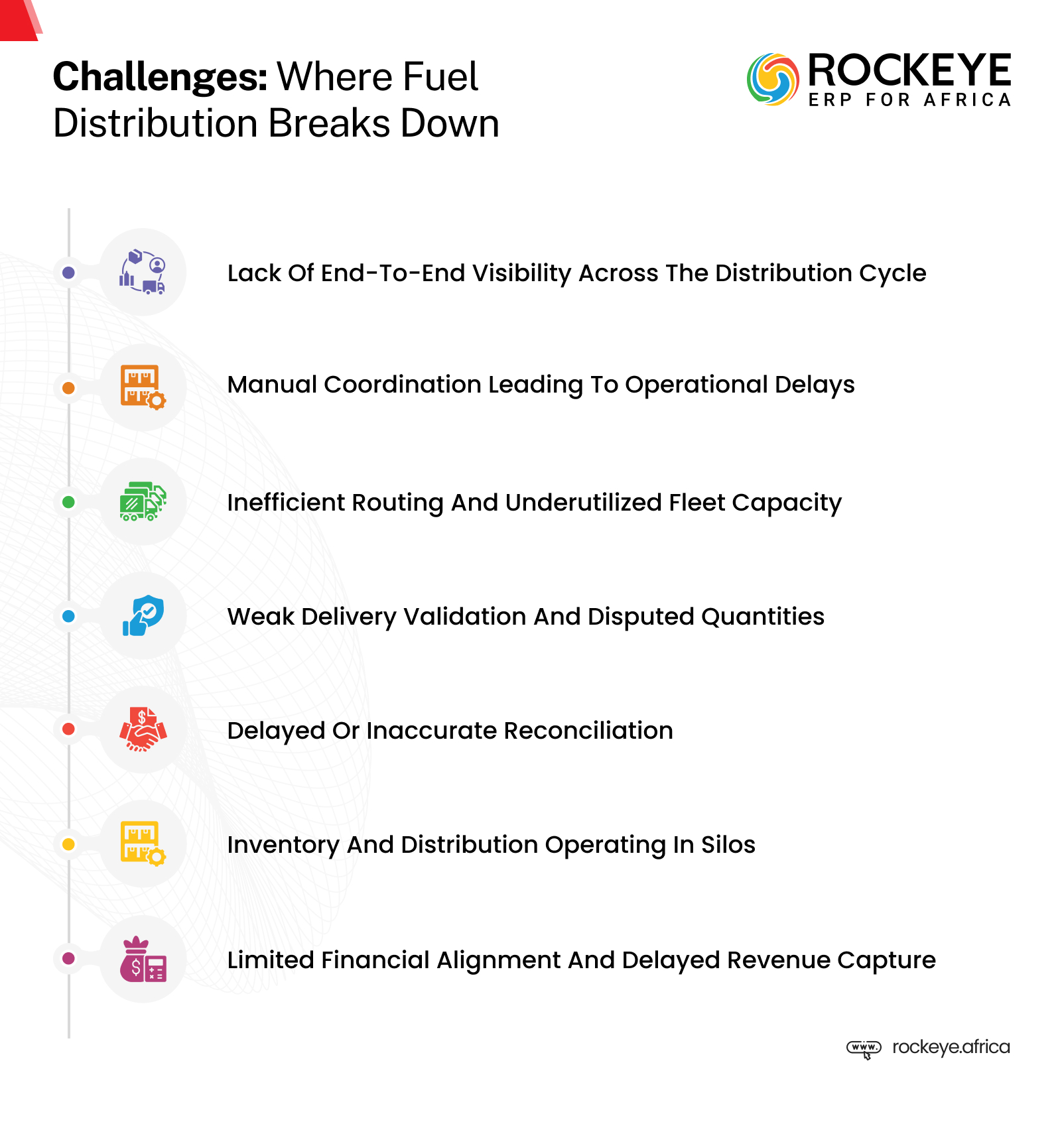
1. Lack of End-to-End Visibility Across the Distribution Cycle
In many operations, visibility stops at dispatch. Once fuel leaves the depot:
- Its exact location becomes uncertain
- Delivery timelines become estimates
- Exceptions are discovered too late
Without real-time, end-to-end tracking, organizations operate with partial awareness of their most critical asset in motion.
This lack of visibility can result in:
- Up to 40% delay in issue detection
- Increased delivery uncertainty
- Reduced operational responsiveness
When you cannot see the full journey, you cannot control it.
2. Manual Coordination Leading to Operational Delays
Distribution often depends on constant communication between teams:
- Dispatch coordinating with drivers
- Drivers updating delivery status
- Stations confirming receipt
When this coordination is manual:
- Information is delayed or incomplete
- Miscommunication becomes frequent
- Execution slows down
Manual coordination can reduce operational efficiency by up to 30–45%, particularly in high-volume distribution environments. Instead of a synchronized system, operations become dependent on human follow-ups.
3. Inefficient Routing and Underutilized Fleet Capacity
Without intelligent planning:
- Tankers are dispatched below capacity
- Routes are not optimized
- Multiple trips replace what could be a single efficient run
This leads to:
- Increased fuel consumption
- Higher operational costs
- Reduced delivery throughput
Industry data shows that poor routing and load planning can increase transport costs by 15–20%, while reducing fleet productivity significantly.
4. Weak Delivery Validation and Disputed Quantities
Delivery is one of the most vulnerable points in the distribution cycle. Without proper validation:
- Delivered quantities are disputed
- Documentation is inconsistent
- Proof of delivery is delayed or missing
This creates:
- Billing inaccuracies
- Customer disputes
- Revenue delays
Organizations relying on manual delivery confirmation processes can face up to 20–30% discrepancy-related disputes, particularly in bulk deliveries.
5. Delayed or Inaccurate Reconciliation
In many systems, reconciliation happens after the fact, sometimes hours or days later. This delay leads to:
- Late identification of variances
- Accumulated discrepancies
- Difficulty tracing the source of losses
Studies indicate that delayed reconciliation can increase undetected product losses by 2–4% annually, especially in high-frequency distribution environments. By the time discrepancies are discovered, recovery is often no longer possible.
6. Inventory and Distribution Operating in Silos
When distribution is not directly linked to inventory systems:
- Stock updates are delayed
- In-transit inventory is not accurately captured
- Receiving stock does not reflect real-time deliveries
This results in:
- Stock mismatches across locations
- Emergency replenishments
- Planning inefficiencies
Organizations operating with disconnected systems can experience up to 50% lower inventory accuracy, directly affecting availability and working capital. Movement without synchronization creates data distortion.
7. Limited Financial Alignment and Delayed Revenue Capture
Distribution is often disconnected from financial systems. This creates delays in:
- Invoice generation
- Revenue recognition
- Payment tracking
When delivery data is not instantly linked to finance:
- Billing cycles extend by 24–72 hours or more
- Cash flow is impacted
- Financial reporting becomes less accurate
In high-volume operations, even small delays in billing can have significant cumulative financial impact. Distribution without financial alignment delays the realization of value.
When Small Gaps Become Large Losses
What makes these challenges critical is not their existence, but their compounding effect. A small delay in visibility leads to a delayed decision, a delayed decision leads to inefficiency, an inefficiency, repeated across hundreds of deliveries, becomes a systemic loss.
Fuel distribution deteriorates through unseen inefficiencies that accumulate over time.
How ROCKEYE ERP Transforms Fuel Distribution Management
The Complete Fuel Distribution Control System—Built for Precision, Scale, and Profitability
Where fuel movement is not planned, visible, validated, synchronized, or financially aligned; fuel distribution networks break.
What defines a high-performance distribution network is not how many deliveries are made but how well every stage of that movement is engineered, controlled, and continuously optimized.
ROCKEYE ERP brings all of these components together into a single, real-time system, turning distribution into a fully orchestrated, intelligence-driven operation.
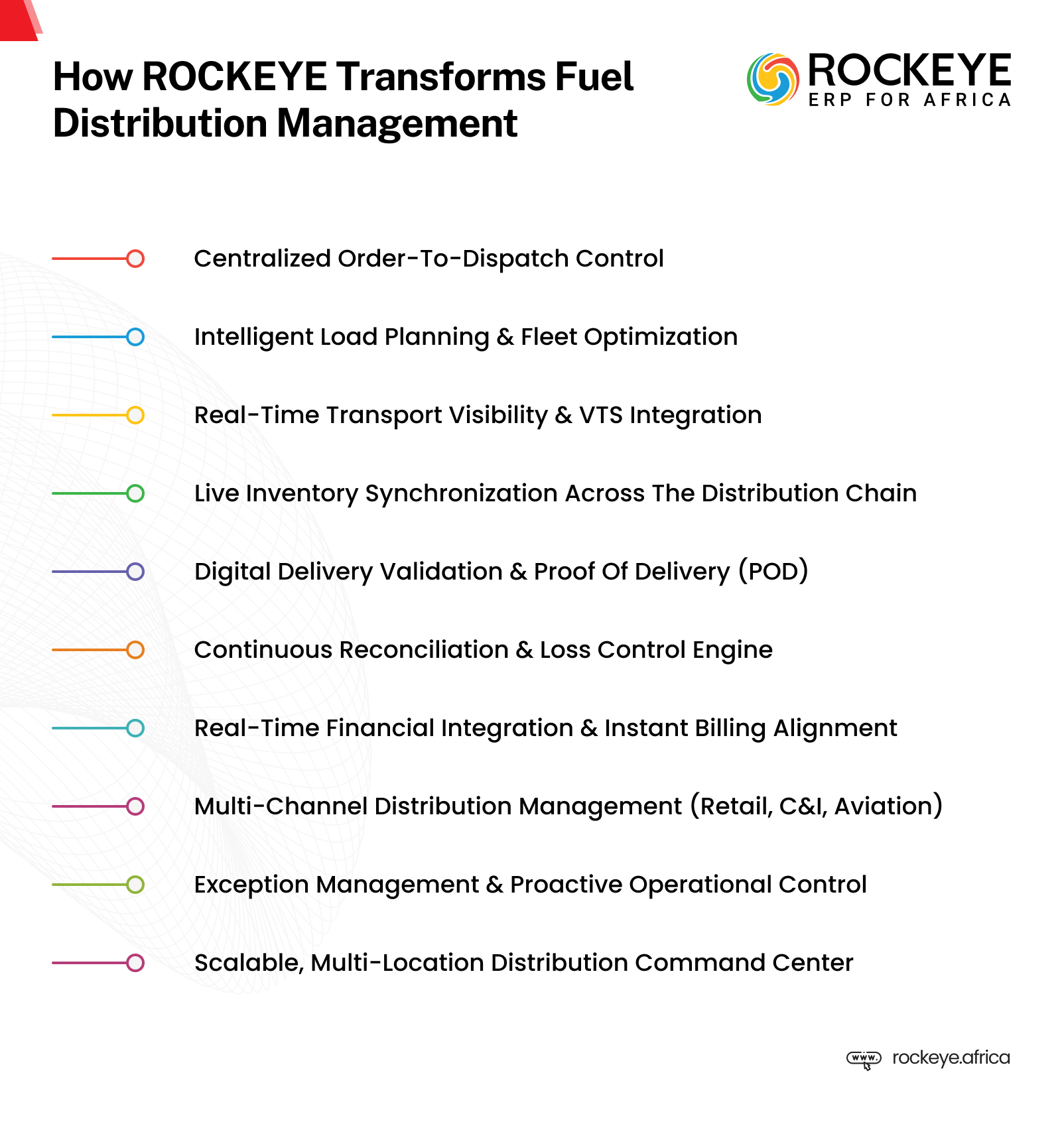
1. Centralized Order-to-Dispatch Control
ROCKEYE ERP establishes a single command layer for:
- Order capture and validation
- Stock-based allocation
- Dispatch planning
Every order is processed with full visibility of:
- Available inventory
- Delivery priority
- Operational constraints
This eliminates allocation errors and improves dispatch efficiency by up to 40–50%, ensuring that every delivery begins with precision and control
2. Intelligent Load Planning & Fleet Optimization
ROCKEYE ERP ensures that every tanker movement is optimized before it begins. It enables:
- Maximum tanker capacity utilization
- Multi-drop delivery optimization
- Dynamic route sequencing
This transforms fleet operations from reactive dispatching to planned efficiency, improving:
- Fleet utilization by 20–30%
- Overall transport cost efficiency by 10–15%
Every trip becomes cost-efficient, not just operationally necessary.
3. Real-Time Transport Visibility & VTS Integration
ROCKEYE ERP integrates directly with Transport and Vehicle Tracking Systems (VTS), enabling:
- Live tanker tracking
- Geo-fencing and route monitoring
- Real-time delivery progress updates
- Driver behavior insights
This means that fuel in transit is never “out of sight.” Organizations gain up to 100% real-time visibility, improving delivery reliability and increasing on-time performance by over 35%.
4. Live Inventory Synchronization Across the Distribution Chain
ROCKEYE ERP connects distribution directly with inventory at every stage. The moment a tanker is:
- Loaded → inventory is reduced
- In transit → stock is tracked as moving inventory
- Delivered → receiving inventory updates instantly
This eliminates lag between physical movement and system records, improving inventory accuracy by over 50–60%. Distribution and inventory operate as one continuous system.
5. Digital Delivery Validation & Proof of Delivery (POD)
ROCKEYE ERP digitizes delivery confirmation to eliminate ambiguity. It enables:
- Real-time quantity validation at delivery point
- Digital, geo-tagged proof of delivery
- Timestamped transaction verification
This removes disputes and strengthens accountability, reducing delivery discrepancies by up to 70%. Every delivery becomes verifiable, traceable, and audit-ready.
6. Continuous Reconciliation & Loss Control Engine
ROCKEYE ERP embeds reconciliation directly into the distribution lifecycle. It continuously tracks:
- Loaded vs delivered quantities
- Tanker discharge vs expected volumes
- Variances across every delivery cycle
This enables:
- Immediate variance detection
- Early loss identification
- Clear accountability across stakeholders
Organizations can reduce distribution-related losses by 2–4% annually, recovering revenue that would otherwise remain hidden.
7. Real-Time Financial Integration & Instant Billing Alignment
ROCKEYE ERP ensures that every physical movement is financially captured in real time. It enables:
- Automatic invoice generation upon delivery confirmation
- Real-time revenue recognition
- Alignment between delivered volume and billed value
This reduces billing cycle time by 30–50%, improving cash flow and eliminating delays between operations and finance. Distribution becomes commercially complete the moment delivery happens.
8. Multi-Channel Distribution Management (Retail, C&I, Aviation)
ROCKEYE ERP is built to handle the full diversity of downstream distribution networks:
- Retail: High-frequency station replenishment
- Commercial & Industrial: Bulk, contract-based deliveries
- Aviation: Precision-driven, compliance-heavy fueling
All channels operate within a single system, ensuring:
- Standardized execution
- Centralized visibility
- Consistent performance
This improves cross-channel distribution efficiency by up to 35–45% without increasing complexity.
9. Exception Management & Proactive Operational Control
ROCKEYE ERP transforms distribution from reactive to proactive through:
- Real-time alerts for route deviations
- Delivery delay notifications
- Quantity variance alerts
- Operational anomaly detection
Instead of identifying issues after impact, teams respond in real time. This improves response speed by over 40% and significantly reduces operational disruptions.
10. Scalable, Multi-Location Distribution Command Center
ROCKEYE ERP provides centralized control across:
- Multiple depots
- Extensive retail networks
- Cross-border distribution operations
With support for:
- Multi-company structures
- Multi-currency environments
- High transaction volumes
Organizations can scale operations while improving efficiency by 35–50%, without losing control or visibility.
From Distribution Activity to Distribution Intelligence
ROCKEYE ERP does not just improve fuel distribution, it redefines through transformation:
- Disconnected execution → Unified orchestration
- Delayed visibility → Real-time control
- Manual validation → Automated accuracy
- Hidden losses → Measurable performance
Every litre is:
- Planned before movement
- Tracked during transit
- Verified at delivery
- Reconciled instantly
- Accounted for financially
With ROCKEYE ERP, fuel distribution becomes predictable, measurable, and fully optimized turning what was once a cost center into a strategic engine of efficiency, control, and profitability.
Conclusion
Control Is the New Currency in Fuel Distribution
Across downstream operations, the difference between average performance and high-performing networks is becoming increasingly clear. It is not defined by scale, fleet size, or even market presence.
It is defined by control over:
- Where fuel is at any given moment
- How efficiently it is being moved
- Whether every delivery is accurate and validated
- How quickly that movement translates into revenue
Without this level of control, distribution becomes reactive. Costs rise gradually. Losses remain hidden. Decisions are delayed. And over time, these small inefficiencies compound into significant operational and financial impact.
This is the shift that defines modern fuel distribution and this is where ROCKEYE ERP fundamentally changes the equation.
By unifying dispatch, transport, inventory, delivery validation, reconciliation, and financial alignment into a single platform, ROCKEYE ERP brings clarity to complexity. It ensures that every litre in motion is not just tracked but fully accounted for, from depot to final delivery.
The result in a distribution network that is transparent, accountable, scalable and financially precise.
In an industry where margins are tight and execution is everything, the ability to operate with this level of precision is what separates organizations that move fuel from those that master distribution.