

How Real-Time Analytics Can Cut Fuel Terminal Costs?
The hidden costs eating terminal margins
Fuel terminals are the critical hubs of downstream oil and gas operations in Africa, handling massive volumes through jetties, storage tanks, and loading bays. Yet many terminals lose 5–15% of margins to inefficiencies: unplanned vessel delays, suboptimal tank utilization, manual reconciliation errors, product discrepancies, and reactive maintenance. These issues compound in African contexts with variable supply, regulatory pressures, and infrastructure constraints.
ROCKEYE’s Terminal Automation System (TAS), combined with real-time analytics, transforms terminals from cost centers into efficient operational assets. While the Trade module manages all commercial, supply, and throughput activities up to the point where fuel reaches the terminal, TAS takes over terminal-side operations—integrating jetty scheduling, tank gauging, automated product movement, and financial postings. This creates a continuous, live data foundation that enables operational visibility, tighter inventory control, and analytics-driven cost optimization.
1. Optimize jetty and vessel scheduling to reduce demurrage
Demurrage charges from delayed vessels can run into thousands of dollars per day, often driven by limited visibility into laycan windows, vessel positions, customs clearance status, and contractual discharge timelines. In ROCKEYE, the Trade module manages these upstream commercial and supply-side activities—monitoring live vessel movements, laycan schedules, contractual terms, and expected arrival timelines before product reaches the terminal.
Once the vessel arrives, the Terminal Automation System (TAS) manages berth allocation, bay availability, tank readiness, and discharge sequencing. The integration between Trade and TAS ensures commercial commitments align with terminal capacity, creating a real-time data foundation that reduces demurrage exposure, improves berth planning, and optimizes product flow across multiple bays and grades.
Dynamic scheduling algorithms analyze arrival patterns, tank space, and downstream demand to recommend optimal sequencing and buffer times, preventing overlaps or idle berths. Operators see projected demurrage risks on dashboards and can re-prioritize loadings proactively. Terminals using similar systems report 20–40% reductions in demurrage exposure by minimizing wait times and aligning vessel plans with actual throughput capacity.
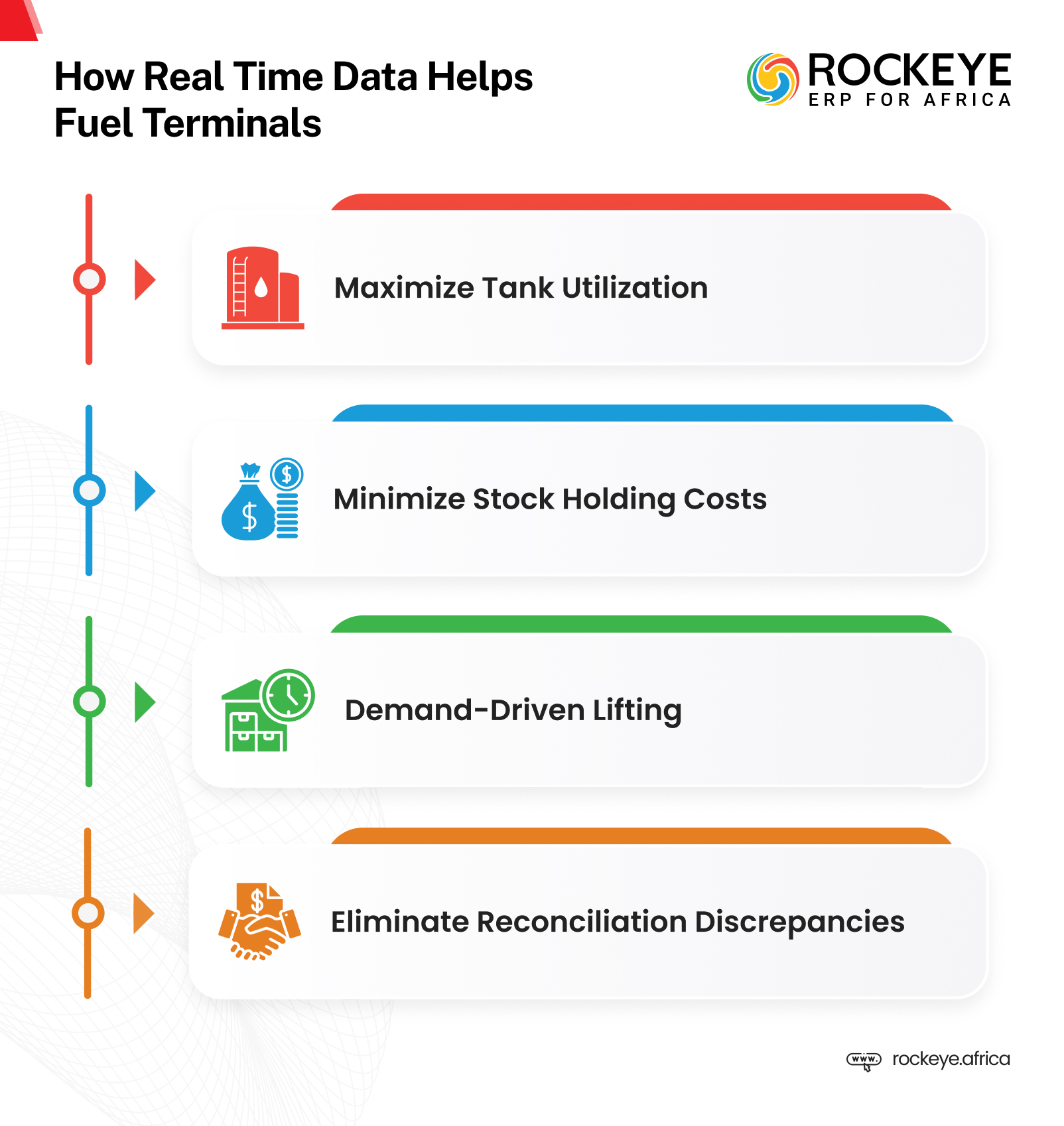
2. Maximize tank utilization and minimize stock holding costs
Suboptimal tank allocation can lead to segregated stocks remaining idle longer than necessary, tying up working capital and increasing risks such as evaporation losses, quality degradation, or operational inefficiencies. In ROCKEYE, the Fluid Inventory (iFluid) module manages all stock-related activities, capturing real-time tank levels, temperatures, densities, and flow data through integrated gauges and measurement systems.
While the Terminal Automation System (TAS) supports operational terminal workflows, iFluid provides the centralized inventory intelligence—powering analytics that optimize blending strategies, stock transfers, reconciliation, and depletion sequencing to improve utilization, reduce losses, and maintain accurate inventory visibility across terminals and depots.
Analytics dashboards highlight underutilized tanks or risky overfills, suggesting automated transfers to balance the system based on incoming vessels, depot lifts, and product expiry. This approach can boost average tank utilization from 70% to 90%+, directly cutting holding costs and freeing capacity for higher-margin products without expanding physical infrastructure.
3. Eliminate reconciliation discrepancies and leakage
Manual meter readings, dip measurements, and post-lift reconciliations often create discrepancies that erode margins and lead to disputes with suppliers, transporters, or customers. In ROCKEYE, the Trade module manages throughput accounting, custody transfer validation, and commercial reconciliation—integrating metering data from gantry and pipeline operations with tank dips, vessel figures, and contractual terms.
While terminal automation systems support the operational capture of movement data, Trade provides real-time validation and variance monitoring, enabling faster dispute resolution, improved accuracy in financial postings, and stronger control over product accountability across the supply chain.
Embedded analytics drill into outliers—such as unusual shrinkage rates or meter drifts—correlating them with temperature, flow speeds, or operator shifts to pinpoint root causes. Terminals achieve near-zero unreconciled losses, recovering 1–3% of throughput value previously written off, while automated audit trails strengthen compliance and partner relationships.
4. Proactive maintenance to cut downtime and repair expenses
Reactive maintenance on pumps, valves, and pipelines leads to unexpected breakdowns, halting loadings and incurring emergency repair premiums. ROCKEYE TAS analytics ingest equipment telemetry (vibration, pressure, runtime) alongside operational data to predict failures before they occur.
Predictive models score asset health in real time, prioritizing interventions based on impact to throughput. Maintenance teams receive mobile alerts for scheduled upkeep during low-activity windows, reducing unplanned downtime by 30–50% and extending equipment life. This shifts terminals from firefighting to planned reliability, stabilizing costs year-over-year.
5. Demand-driven lifting to smooth throughput and reduce idle capacity
Terminals often face peak loads from ad-hoc depot requests or price-driven rushes, causing overtime costs, rushed operations, or idle capacity. Terminal Management (TAS) handles terminal operations such as scheduling, gantry coordination, and dispatch execution, while Fluid Inventory (iFluid) manages all terminal stock-related information, including tank levels, stock movements, and inventory visibility. Together, they provide real-time insights that help balance terminal throughput with actual inventory positions and operational capacity.
Planners view consolidated demand views and simulate loading schedules to balance gantry utilization across shifts. This smoothes workflows, cuts peak overtime by 25%, and minimizes product demixing from hurried operations, all while improving service levels to depots and stations.
Finance integration for full cost transparency
Real-time analytics shine brightest when tied to financials. ROCKEYE connects TAS data to Finance & Accounting for instantaneous cost capture: demurrage accruals, labor against loadings, maintenance spend per product, and shrinkage impacts on P&L. Terminal managers get live dashboards showing cost per kilolitre loaded, margin erosion by cause, and variance to budget—enabling weekly reviews instead of monthly surprises.
This level of granularity empowers data-driven decisions, like renegotiating supplier terms or adjusting tank leases, often yielding 10–20% overall terminal cost reductions within the first year.
Getting started with terminal analytics ROI
ROCKEYE TAS delivers these analytics out-of-the-box, with minimal setup via IoT integrations and cloud dashboards accessible to operations and finance teams alike. African terminals adopting similar real-time systems see payback in 6–12 months through demurrage savings, leakage recovery, and efficiency gains alone.
By turning raw operational data into actionable insights, real-time analytics don’t just cut costs—they make terminals more resilient, compliant, and responsive in volatile markets, positioning them as profit drivers for the entire downstream network.