


Cloud ERP vs On-Premise ERP for Africa’s Oil & Gas Sector: What Wins in 2026?
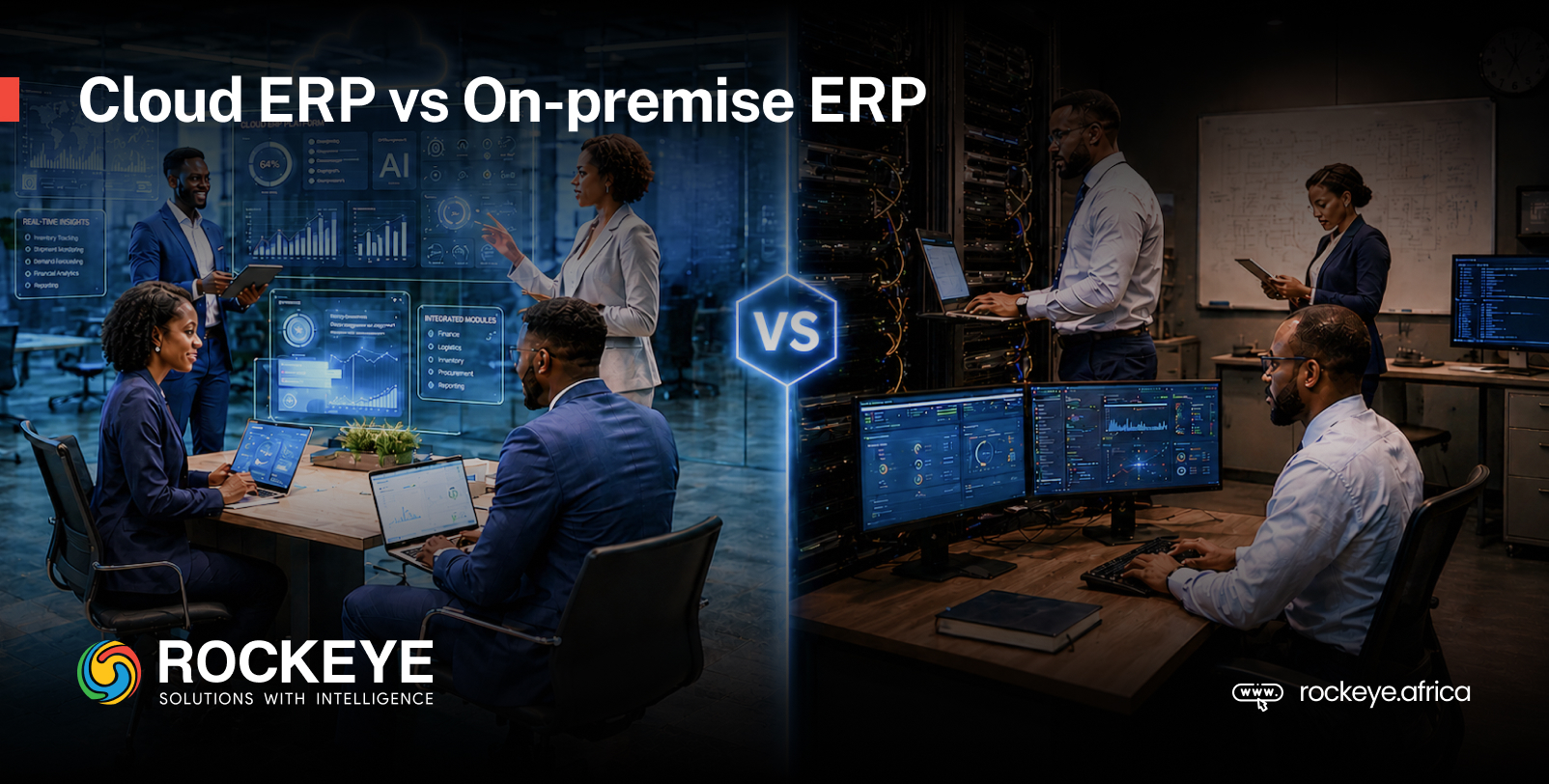
Downstream oil and gas operations across Africa run continuously: terminals load trucks overnight, depots dispatch at dawn, and stations serve peak-hour fuel demand around the clock. ERP systems in this environment must handle volatile fuel volumes, FX fluctuations, regulatory compliance, distributed operations, and inconsistent connectivity without disrupting business continuity.
Cloud ERP promises agility and scalability, while on-premise systems emphasize control and infrastructure ownership. However, the right ERP architecture ultimately depends on operational scale, infrastructure maturity, regulatory requirements, and long-term digital strategy.
Across Africa’s downstream sector, cloud ERP adoption is accelerating because operators increasingly require real-time visibility, mobile-enabled operations, lower infrastructure overhead, and scalable operational coordination across terminals, depots, logistics fleets, and retail fuel stations.
ROCKEYE delivers cloud ERP designed specifically for downstream operational realities, integrating terminal automation, Smart Station operations, logistics coordination, finance, compliance, and mobile field operations into a unified operational ecosystem.
Cost & Scalability
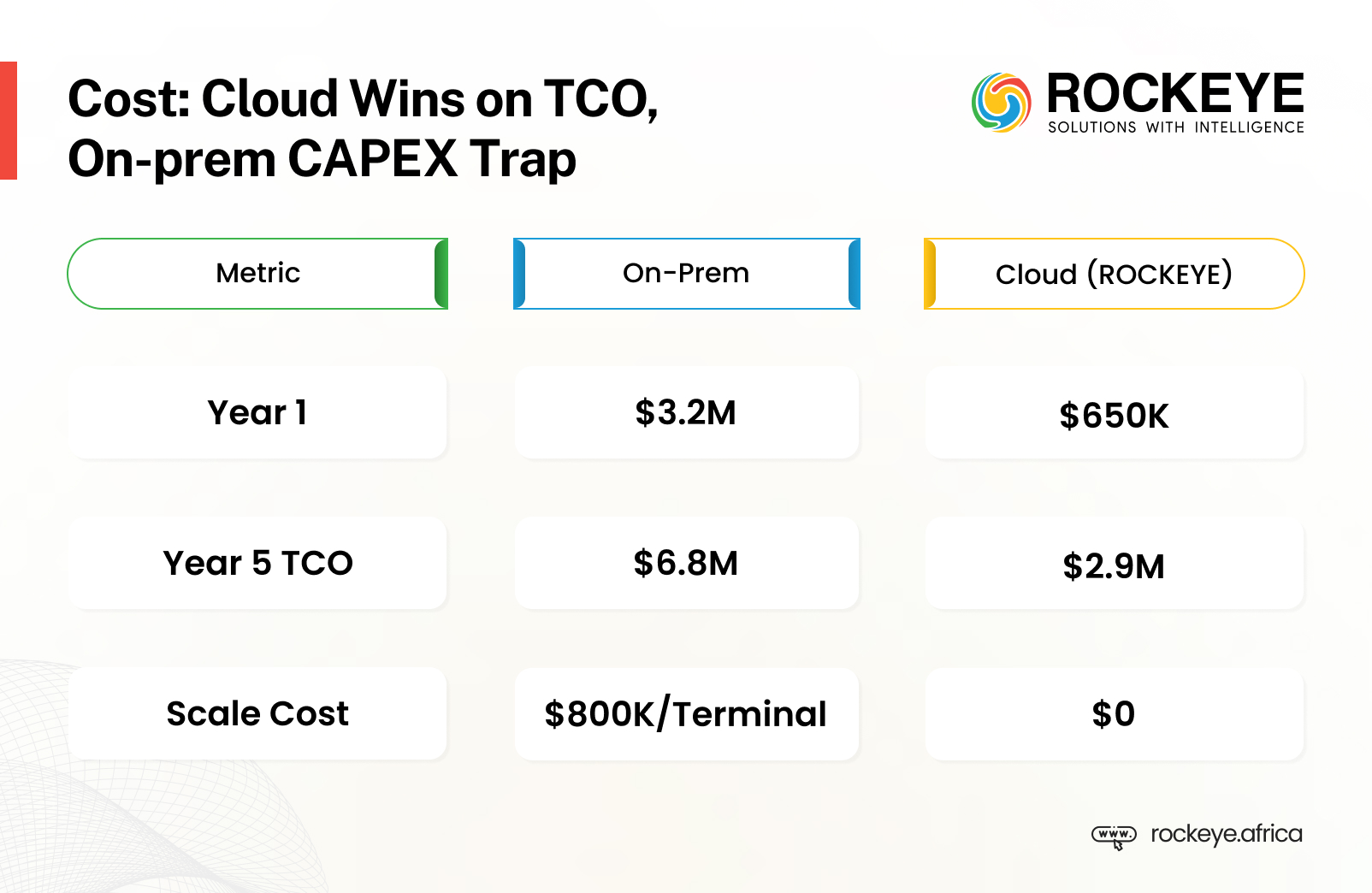
Traditional on-premise ERP environments often require significant upfront investment in servers, networking infrastructure, licensing, and long-term maintenance. Scaling operations may involve additional hardware procurement and infrastructure upgrades.
Cloud ERP environments reduce infrastructure dependency through subscription-based models and elastic scalability. This becomes especially valuable in downstream operations where terminal throughput, fleet movement, and station demand can fluctuate rapidly.
For distributed fuel networks across Africa, cloud ERP architectures generally provide stronger operational flexibility, faster deployment cycles, and lower long-term infrastructure overhead.
Operational Reliability in Distributed Environments
Operational continuity is critical in downstream fuel operations. In many African environments, ERP systems must continue functioning despite unstable power conditions, remote operational sites, and inconsistent network connectivity.
Modern cloud ERP platforms increasingly combine centralized infrastructure with edge processing and offline synchronization capabilities. This allows tank monitoring systems, mobile field applications, and station operations to continue functioning even during temporary connectivity disruptions.
For distributed downstream operations, operational resilience often depends more on intelligent system architecture than on physical server ownership.
Security & Compliance
Security and compliance requirements across downstream oil and gas operations continue to evolve rapidly. Modern ERP environments must support audit trails, financial transparency, inventory traceability, and regulatory reporting.
Cloud ERP environments now commonly support enterprise-grade encryption, role-based access controls, automated backups, and centralized monitoring. Integrated compliance visibility can significantly improve operational governance across terminals, depots, transport operations, and retail networks.
Integration & Operational Synchronization
Downstream oil and gas operations depend on synchronization between multiple operational layers including terminals, logistics fleets, retail stations, finance, and inventory management.
Modern cloud ERP platforms increasingly rely on API-driven integration frameworks, enabling real-time communication between IoT devices, terminal automation systems, financial systems, and operational dashboards.
This creates a more connected operational ecosystem where decisions can be made using real-time intelligence rather than delayed reporting structures.
Mobility & Field Operations
Field operations are becoming increasingly mobile-driven. Depot supervisors, transport coordinators, station managers, and field operators require access to operational intelligence directly from mobile devices.
Cloud ERP platforms generally provide stronger support for mobile-first operations, offline synchronization, remote approvals, and distributed operational monitoring. ROCKEYE provides multi-location fuel station management system across Africa.
Innovation & Future Readiness
As downstream operations become increasingly data-driven, ERP systems are evolving beyond transactional management into operational intelligence platforms.
Cloud ERP architectures generally enable faster deployment of new capabilities such as predictive analytics, AI-assisted forecasting, automated reconciliation, anomaly detection, and sustainability tracking.
This flexibility is becoming increasingly important as downstream operators adapt to evolving regulatory requirements, operational complexity, and competitive pressures.
| Factor | On-Premise ERP | Cloud ERP |
|---|---|---|
| Infrastructure Cost | High upfront CAPEX | Subscription-based |
| Scalability | Hardware dependent | Elastic scaling |
| Remote Accessibility | Limited | Strong |
| Mobile Operations | Complex | Native support |
| Offline Capability | Local only | Hybrid edge/offline |
| Updates | Manual | Continuous |
| Multi-location Visibility | Challenging | Real-time |
| Best Fit | Highly isolated environments | Distributed downstream operations |
The 2026 Verdict for Africa’s Downstream Sector
Industry trends increasingly favor cloud ERP adoption across downstream oil and gas operations due to scalability, operational flexibility, real-time visibility, and lower infrastructure overhead.
However, ERP architecture decisions should ultimately be guided by operational realities rather than technology trends alone. Infrastructure conditions, regulatory environments, network distribution, and operational maturity all influence the right deployment strategy.
For many downstream operators across Africa, cloud ERP platforms are becoming the preferred foundation for achieving synchronized operations across terminals, depots, logistics fleets, retail stations, finance, and compliance.
As operational complexity increases, long-term competitiveness will increasingly depend on operational intelligence, infrastructure resilience, and the ability to make decisions in real time.
Explore how ROCKEYE helps downstream oil and gas operators modernize fuel distribution, digital transformation across Africa’s downstream sector, terminal operations, retail station management, logistics coordination, and operational intelligence across Africa.