

How to Choose the Right ERP Features for Your Downstream Operation in Africa?
Downstream decisions define your survival
Downstream oil and gas in Africa rewards operators who master their networks—terminals, depots, transporters, stations—but punishes those who guess at stock levels, chase transporter discrepancies, or reconcile month-end by hand. With volatile prices, NPA delays, and multi-country regs, your ERP must solve your specific bottlenecks, not check generic boxes.
ROCKEYE offers purpose-built modules (TAS, Smart Station, Inventory, Transporter, Finance, etc.) that integrate end-to-end. The key? Match features to your operation’s realities: terminal-heavy? Retail-focused? Multi-depot sprawl? Here’s how decision-makers pick winners.
Step 1: Map your biggest margin killers first
Start with cold math: which processes leak 2-5% of revenue today? Run a 2-week audit across sites.
Terminal operators prioritize:
- TAS for jetty scheduling and meter accuracy (demurrage 30-50% reduction)
- Inventory + IoT for tank twins (shrinkage from 1.8% to 0.3%)
Depot networks need:
- Smart Logistics + Transporter for verified liftings (dispute resolution 85% faster)
- Vehicle Tracking for ETAs (stockouts down 40%)
Retail-heavy chains demand:
- Smart Station IoT for pump/tank monitoring (availability 98%)
- Trade for dynamic pricing (volume +15%)
Audit checklist:
- Month-end close >5 days? → Finance automation
- Transporter payouts >2% disputed? → Verified PODs
- Station complaints >10/week? → Real-time stock alerts
Skip “nice-to-haves” until core leaks stop.
Step 2: Demand end-to-end integration, not silos
Standalone modules fail because downstream flows continuously: terminal lift → depot receipt → truck dispatch → station sale → finance post.
Must-have integrations:
- TAS liftings → Inventory deduction → Transporter manifest
- Depot stock → Smart Logistics dispatch → Vehicle Tracking ETA
- Station sales → Finance GL → Trade rebate calc
Test in demo: “Show me a truck loading at terminal flowing to station pump sales posted to P&L.” If data doesn’t move seamlessly, walk away.
Africa test: Confirm offline sync for rural stations (2G reconnect) and multi-currency for cross-border depots.
ROCKEYE edge: Native data model means no API breakage during upgrades. One Nigerian operator cut reconciliation from 14 to 2 days across 3 terminals/50 depots.
Step 3: Prioritize mobile + IoT for field realities
Your forecourt attendants, truck drivers, and depot supers live on phones, not desktops. ERP must work offline in dusty sites with spotty power.
Essential field features:
- Mobile approvals: Depot manager OKs truck loads from WhatsApp-integrated alerts
- IoT dashboards: Station pump volumes live on tablet
- Driver apps: GPS-tracked ETAs, digital PODs replace paper
Workforce angle: HRMS ties shifts to verified demand (station sales, truck volumes). No more overstaffing slow sites.
Decision hack: Demo on actual Android phones (not iPads). Ask: “How does a driver contest a short load remotely?”
Step 4: Build for compliance and audit armor
African regs (NMDPRA, EPRA, SON) demand instant proofs. Generic ERPs choke on custom reports.
Non-negotiables:
- Immutable logs: Every meter read, tank dip, valve open timestamped + operator ID
- Digital packs: Tank calibration, customs manifests, safety certs auto-generated
- Finance alignment: IFRS multi-currency, VAT by state/country
Procurement tie-in: Supplier docs centralized, auto-expiring licenses flagged.
Test: “Pull MIDEX audit pack for last 6 months.” Should take <5 mins.
Step 5: Analytics that drive daily decisions
Reporting after month-end is useless. You need now insights: “Which route leaks 0.7%? Which station underperforms?”
Core analytics:
- Cost-per-litre by chain link (terminal → station)
- Shrinkage heatmap (tank/route/operator)
- Station margin ranking (sales vs costs)
- Transporter scorecard (OTD, disputes)
Africa volatility test: Price change simulations ripple terminal blends → depot pricing → station POS.
HR/Finance bonus: Labor cost vs throughput; working capital tied to inventory turns.
Step 6: Scale for growth without reimplementation
Today’s 50 stations become 200. One terminal adds two depots. ERP must flex.
Future-proof checks:
- Cloud scalability: Add sites without servers
- White-label mobile: Branded driver/station apps
- Module independence: Start TAS, add Smart Station later
- RPA ready: Auto-reconciliations scale with volume
Vendor question: “Show multi-country rollout (NG → GH → KE).”
The winning ERP feature set for your operation
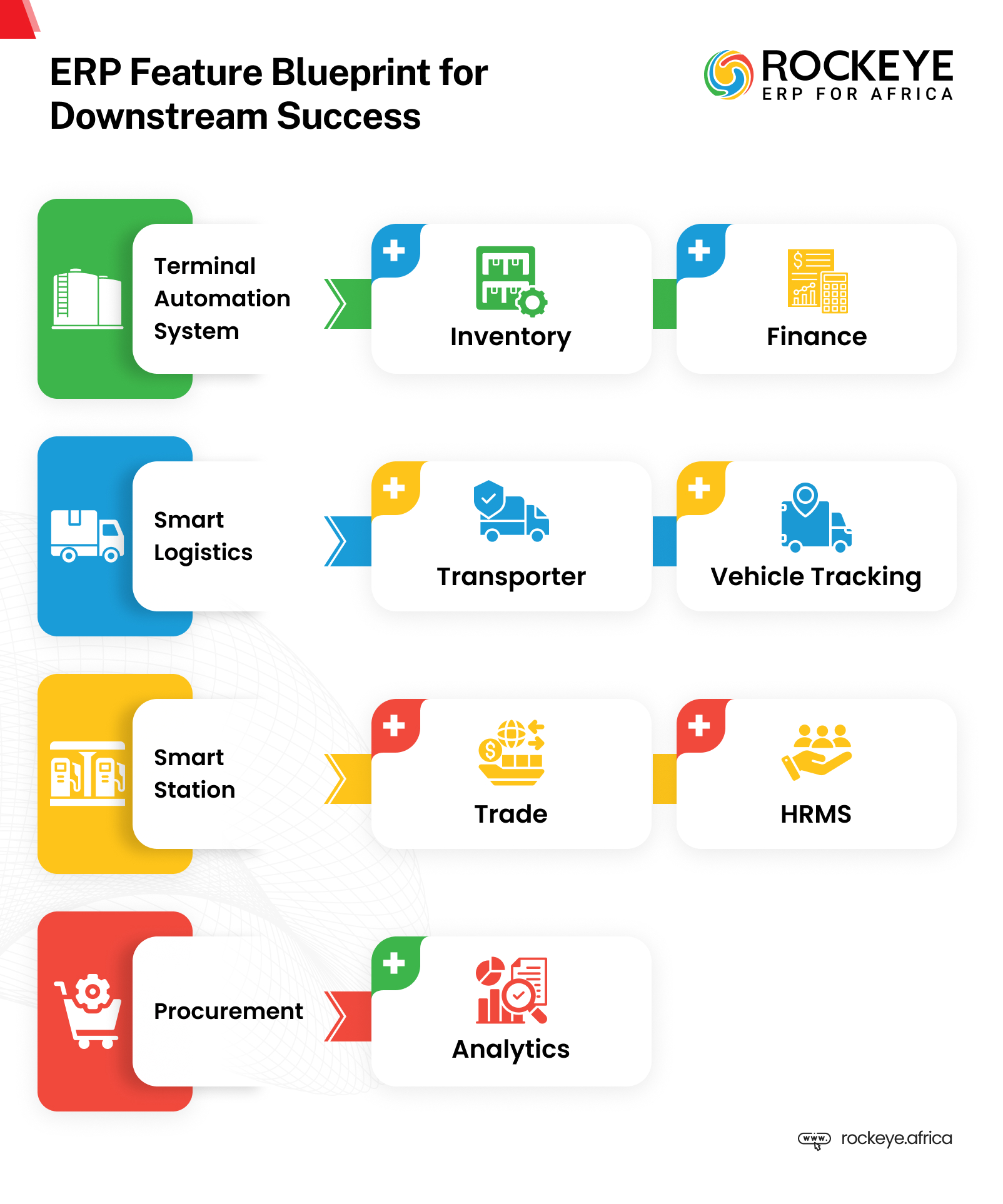
Terminal-dominant: TAS + Inventory + Finance (demurrage/shrinkage focus)
Depot sprawl: Smart Logistics + Transporter + Vehicle Tracking (supply reliability)
Retail scale: Smart Station + Trade + HRMS (customer/forecourt ops)
Enterprise: All above + Procurement + Analytics (end-to-end control)
Red flags: Heavy customization promises, desktop-only, no IoT, integration “later.”
Green lights: Live demos with your data, African case studies (MRS Oil Nigeria-style), offline/mobile proof.
Your operation’s ERP backbone starts today
The right ERP features don’t transform downstream overnight—they eliminate daily friction so your team focuses on growth: new stations, better suppliers, reliable service. In Africa’s volatile market, operators with integrated TAS-Smart Station-Finance chains don’t just survive—they expand while competitors reconcile spreadsheets.
Map your leaks. Demo end-to-end. Prioritize integration over features. Your network will thank you with tighter margins and happier customers.