

Integrating ERP with IoT Sensors for Smart Terminal Management
Terminals under pressure in African downstream
Running a fuel terminal in Africa means coordinating vessel arrivals through congested ports, managing dozens of tanks across multiple products, and loading hundreds of trucks daily while watching every litre for shrinkage. Add volatile supply from global markets, NPA port delays, and regulatory inspections that demand instant documentation, and the margin for error shrinks to nothing. Most terminals still rely on manual dip measurements, paper manifests, and Excel reconciliations that create blind spots and reaction delays.
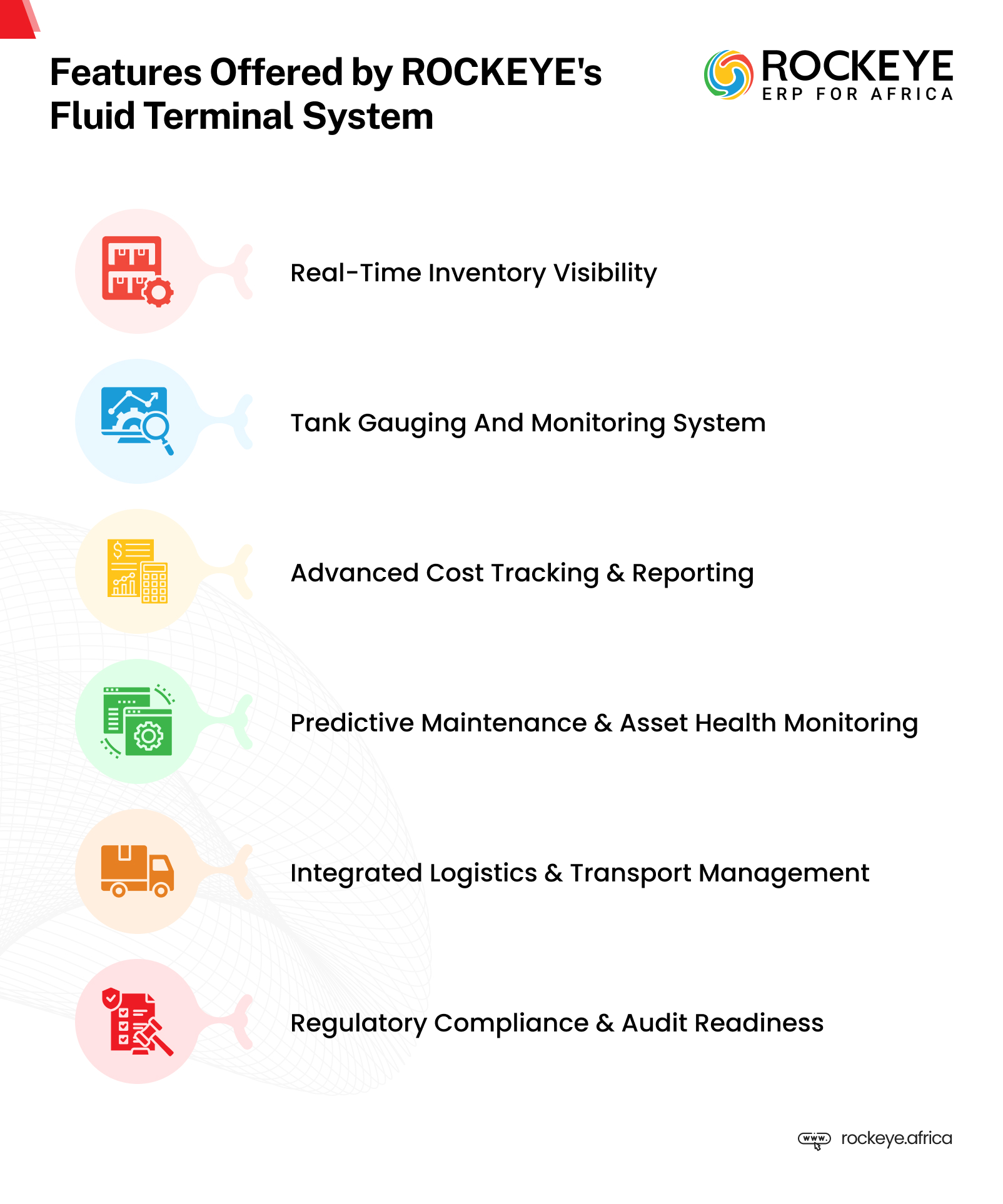
ROCKEYE’s Terminal Automation System (TAS) changes this equation. When integrated with IoT sensors for tanks, pipelines, and gantries, TAS connects directly to Inventory, Finance, Transporter, and Trade modules. Operations teams get live data that drives decisions, not just reports that arrive too late.
Challenge 1: Manual tank monitoring misses critical shifts
Terminal operators know the pain: you dip tanks manually every few hours, but between measurements, products stratify, water builds up, or evaporation quietly eats margins. A single tank misread during vessel planning can force emergency transfers or demurrage payments when ullage isn’t ready.
TAS with IoT solves this through continuous monitoring. Radar gauges and temperature sensors stream tank levels and conditions every 15 seconds into the ERP. Instead of hourly guesses, supervisors see exact net volumes, water cuts, and available blending space across the tank farm. The system flags tanks approaching high-high limits or showing unusual density shifts, letting teams act before problems cascade.
Operational impact: Inventory accuracy jumps from 95% to 99.5%. One depot operator cut mystery shrinkage from 1.8% to 0.4% because water buildup in kerosene tanks now gets caught within hours, not days. Finance posts reliable stock values daily instead of arguing month-end variances with suppliers.
Africa angle: In regions with power fluctuations, solar-powered sensors keep data flowing 24/7, syncing to the cloud when connectivity returns.
Challenge 2: Gantry loading disputes erode trust and margins
Every terminal manager has stories of truck drivers contesting meter readings, arguing over 50-litre discrepancies that add up across 200 daily loadings. Manual nozzle changes between products risk contamination, while queueing trucks burn labor hours and diesel waiting.
TAS gantry automation with IoT flow meters eliminates these fights. Coriolis meters on each loading arm verify volumes against manifests in real time. Truck scanners match loads to correct bays by product and destination. When a loading completes, TAS instantly deducts from Inventory, notifies the Transporter module for proof-of-delivery, and posts the value to Finance.
Operational impact: Loading cycles drop from 18 minutes to 9 minutes per truck. Disputes fall 85% because digital tickets show meter proofs and timestamps. Logistics teams pay transporters only for verified deliveries, cutting leakage in cash-heavy environments. One Nigerian terminal recovered N120M ($75K) Year 1 from previously untraceable losses.
Multi-location benefit: Head office sees live gantry throughput across three terminals, reallocating trucks from slow sites to high-demand ports instantly.
Challenge 3: Vessel delays trigger expensive demurrage
African terminals lose fortunes to demurrage when vessels wait for berth clearance, tank readiness, or customs processing. Shipping agents demand updates hourly, but without live data, you’re guessing when ullage will be available or which products need priority blending.
TAS jetty management with IoT berth sensors creates predictive scheduling. Berth cameras and tide gauges track vessel positioning while tank sensors confirm product availability. The ERP runs arrival-to-loading simulations, factoring depot liftings from the Transporter module and station demand from Inventory data. Operations teams share digital ullage guarantees with agents 24 hours before arrival.
Operational impact: Demurrage claims dropped 45% at a Ghana terminal after implementation. Vessel turnaround improved from 36 hours to 22 hours because customs clearances attach directly to digital manifests. Finance accrues port costs per vessel automatically, giving CFOs accurate margin visibility by product.
Regulatory win: NPA inspectors access digital logs instantly, eliminating 2-day documentation scrambles during port audits.
Challenge 4: Reactive maintenance halts peak operations
Nothing kills terminal throughput like a gantry pump failing at 6 AM when 80 trucks queue. Maintenance teams react to breakdowns because nobody tracks vibration patterns or runtime hours across 50+ critical assets.
IoT asset monitoring feeds TAS Maintenance workflows. Vibration sensors on pumps and valves score failure risks daily. When a gantry arm shows elevated readings during low-activity hours, the system schedules service before peak demand hits. Work orders pull historical data from Finance for cost tracking and Inventory for spare parts availability.
Operational impact: Unplanned downtime fell 52% across deployed terminals. Maintenance costs dropped 28% because repairs happen during night shifts instead of emergency premiums. HRMS schedules technicians against verified demand, eliminating overstaffing. One operator extended pump rebuild cycles from 18 to 24 months.
Infrastructure reality: Sensors run 30 days on battery with solar backup, perfect for remote tank farms with unreliable grid power.
Challenge 5: Compliance demands instant audit trails
Regulators like Nigeria’s MIDEX or Kenya’s EPRA want tank calibration certificates, meter proofs, and safety logs at a moment’s notice. Paper records disappear, digital files sit in email inboxes, and manual compilations take days while operations halt.
TAS creates immutable digital threads. Every tank dip, meter reading, valve operation, and truck loading timestamps to the ERP with operator ID. IoT gas detectors log H2S levels continuously. When inspectors arrive, Finance pulls compliance packs showing product movements against regulatory limits—no manual recreation needed.
Operational impact: Audit prep time dropped from 5 days to 2 hours. Terminals pass inspections first time 92% vs 65% previously. Insurance premiums fell 18% after carriers verified continuous monitoring. Procurement tracks calibration certificates automatically, preventing meter fines.
Challenge 6: No visibility into true terminal costs
Terminal managers fight for budget with incomplete data: “How much did yesterday’s jetty delay really cost?” Finance needs landed costs per product for margin analysis, but manual allocations guess labor and shrinkage splits.
ERP-wide cost transparency emerges naturally. TAS captures demurrage accruals per vessel, labor hours per shift against loadings, shrinkage by tank, and maintenance costs by gantry. Dashboards show cost-per-kilolitre by product (Diesel: N12.50, Jet: N18.20) and variance to budget. Trade module forecasts terminal cashflow from confirmed liftings.
Operational impact: Terminals cut OPEX 22% Year 1 through data-driven decisions like consolidating low-volume products or renegotiating berth leases. Multi-location operators shifted blending capacity between Lagos and Warri ports, saving N450M annually.
The operational backbone terminals need
Integrating IoT sensors with ROCKEYE ERP’s depot management software doesn’t just digitize terminals—it rewires how they run. Terminal managers move from fighting fires to directing traffic. Finance gets daily P&L instead of monthly surprises. Depot customers receive reliable ETAs because terminals plan with live data.
In African downstream, where supply shocks hit weekly and regulators visit monthly, this level of integration turns terminals from necessary costs into competitive advantages. Smart terminals don’t just handle more volume—they handle uncertainty better, recover more margin, and scale across countries without losing control.
As IoT sensors get cheaper and connectivity improves, ERP-integrated terminals will define downstream leadership. The operators planning this integration today will own tomorrow’s most reliable networks while others scramble with yesterday’s spreadsheets.