

Improving Customer Experience at Retail Fuel Stations with ERP Tools
Why customer experience at the pump really matters
For many customers in Africa, the fuel station is one of the most frequent physical touchpoints they have with a brand. Long queues, “no fuel” signs, unclear pricing, slow billing, or doubts about pump accuracy quickly erode trust and push drivers toward competitors. At the same time, station operators are juggling inventory, staff, cash, utilities, and compliance—often with limited visibility and paper-based processes.
ERP tools designed specifically for fuel retail, like ROCKEYE’s Smart Station solution combined with its wider downstream suite, help operators shift from reactive firefighting to consistently reliable, transparent, and efficient service at every site. The result is a better experience at the pump and inside the shop, without adding more people or manual work.
1. Always-in-stock stations: availability as the first CX pillar
Nothing damages customer experience faster than driving into a station and discovering there is no product. Stockouts often happen because head office and depots don’t have an accurate, real-time view of what is happening in underground tanks across the network.
ROCKEYE Smart Station connects fuel stations across geographies and provides real-time insights into tank levels, dispenser activity, and station status on a centralized dashboard. Automatic Tank Gauging (ATG) integration gives accurate information about fuel and water levels, temperature, and overall stock in each tank, so operators can detect low stock, anomalies, or contamination before they impact customers. These readings can be fed into ROCKEYE’s inventory and logistics capabilities, so depots and planners see low-stock alerts early and schedule replenishment runs before pumps run dry.
The practical outcome for customers is simple but powerful: when they drive in, fuel is almost always available and of the expected quality, which builds trust and loyalty over time.
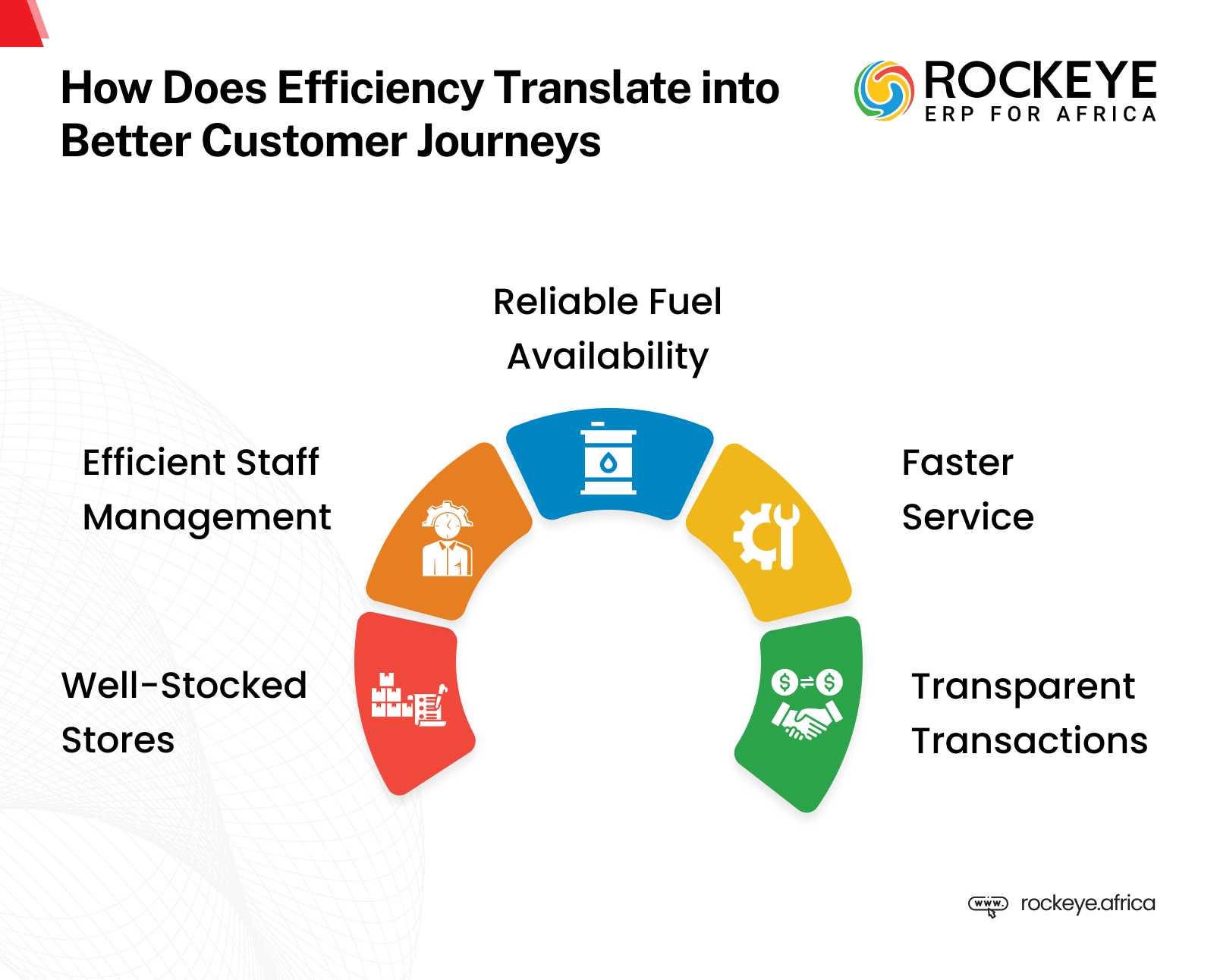
2. Faster, smoother service at the forecourt
From the customer’s point of view, a good visit to a station is quick, predictable, and frictionless—from arrival to refuelling to payment. Many African stations, however, still rely on manual pump control, paper shift sheets, and separate POS systems, which slows transactions, complicates reconciliation, and creates room for errors.
ROCKEYE’s Smart Station introduces automated fuel dispensing that allows operators to control multiple nozzles and pumps through a centralized on–off mechanism, simplifying operations at busy forecourts. The system automatically reads meter values, records sales, and links them to POS and payment records, reducing the time attendants spend on manual readings and paperwork. Offline support through a local server at the station ensures that even when internet connectivity is poor, dispensing, sales recording, and shift operations can continue uninterrupted, with data synchronizing to the cloud once connectivity returns.
Real-time reporting on sales, shift performance, and cash collection also helps managers reorganize pumps, open or close lanes, and adjust staffing levels based on actual demand rather than guesswork, which reduces queue times and makes visits feel more efficient for customers.
3. Building trust through accurate, transparent transactions
Customer confidence in a station often hinges on three questions: “Did I really get the volume I paid for?”, “Is the price correct?”, and “Can I get a clear record of my purchase if I need it later?”. In cash-heavy environments, inconsistent processes and weak controls can undermine this trust.
Smart Station helps by tightly linking pump readings, ATG data, and POS transactions. Automatic meter reading and sales recording ensure that what is dispensed at the nozzle matches what is recorded in the system, reducing the risk of manipulation or mis-keyed values. Integrated POS management makes sure all types of sales—fuel and non-fuel—are captured and reconciled within the same platform, simplifying end-of-day reconciliation and making discrepancies easier to spot and resolve.
Because ROCKEYE’s fuel retail solutions are part of a broader ERP, data from stations can flow into centralized finance and reporting modules, giving companies the ability to generate clear, auditable records for customers, corporate accounts, and regulators alike. This combination of accurate dispensing, consistent pricing, and reliable documentation creates a transparent environment that customers can trust.
4. Improving the experience beyond fuel: shop, services, and insights
Modern fuel stations are more than just pumps; they are also convenience stores and service points, and customers increasingly expect a smooth experience across all of these touchpoints. Managing non-fuel inventory, pricing, promotions, and sales manually can lead to stockouts on popular items, slow billing, and missed cross selling opportunities.
ROCKEYE’s Smart Station supports reporting not only on fuel sales, but also on non-fuel sales, staff performance, and cash collection, all from one interface. Its integration with inventory and sales modules allows operators to track liquid and goods inventory with intuitive views and dashboards, helping keep shelves stocked and minimizing lost sales due to unavailable items.
By analyzing usage patterns, sales data, and shift performance, station owners can better understand customer behaviour—such as which locations respond to certain promotions or what products sell best at different times of day—and then adjust product mix, store layout, or offers accordingly. This makes each visit more relevant and convenient for customers, turning stations into destinations rather than just refueling stops.
5. Empowering staff to deliver better service
Customer experience at the station is heavily shaped by attendants and supervisors. If shifts are mismanaged, staff are overworked, or there is little visibility into performance, even good technology won’t translate into a consistently positive experience.
Smart Station includes staff management features that let station managers review and manage staff on duty, configure shifts and working hours, track attendance, monitor performance, and assign pumps to specific attendants. Real-time dashboards highlight shift operations and staff-related information, helping managers identify which attendants handle the most transactions, who has more discrepancies, and where additional training or support might be needed.
Combined with ROCKEYE’s HRMS capabilities at the enterprise level, this creates a foundation for aligning staffing, training, and incentives with the type of customer experience the brand wants to deliver. Better-managed teams tend to provide faster, friendlier, and more consistent service, which customers quickly notice.
6. Managing the experience across multi-station networks
For brands running tens or hundreds of stations across different cities or countries, the challenge is not just delivering a good experience at one site—it is maintaining a consistent standard everywhere while still allowing local flexibility. Without centralized tools, head office has little visibility into which stations are underperforming on service or compliance and why.
ROCKEYE’s Fuel Station Management System is designed to connect geographically dispersed chains of fuel stations and provide a single interface from which owners and leadership teams can monitor activities, inventory, sales, staffing, and downtime for the entire network. Smart alerts notify them of low stock, unusual downtime, or deviations in sales patterns in real time, so they can “manage by exception” rather than trying to review every station manually.
Because the solution sits on a cloud architecture with auto sync, executives and regional managers can access up to date information on any site from anywhere, on web or mobile, while stations themselves can continue operating even when internet is intermittent thanks to local offline support. This combination of centralized control and local resilience is particularly important in African markets, where infrastructure and connectivity can vary from one region to another.
From operational control to better customer journeys
Improving customer experience at retail fuel stations is not about adding more screens in the shop or launching flashy campaigns; it is about getting the basics right—reliably, every day, at every site. That means ensuring fuel availability, short queues, accurate and transparent transactions, a well stocked shop, safe operations, and staff who are supported by clear processes and data.
By using oil and gas ERP tool like ROCKEYE Smart Station alongside integrated inventory, logistics, finance, and HR modules, downstream operators in Africa can turn their fuel stations into well run, data driven service points that meet these expectations consistently. When customers know that your stations are more likely to have product, serve them quickly, charge them correctly, and offer a convenient experience, they are far more likely to return—and to bring others with them.