


State of Digital Transformation in Oil and Gas Sector Across Africa
A Continent in Transition: Where Digital Meets Energy Reality
In Africa, digital transformation in oil and gas is no longer a future ambition; it is unfolding in real time, but at different speeds, across different markets, and with very different levels of maturity.
In some regions, companies are already leveraging real-time systems, automated terminals, and integrated data environments to drive efficiency and scale. In others, critical operations still depend heavily on manual processes, fragmented tools, and delayed reporting cycles.
This contrast is what defines the current state of the industry.
It is not a question of whether digital transformation exists in Africa; it clearly does. The real picture is more nuanced. It is a landscape where progress and gaps coexist, where investment is increasing, but integration is still evolving, and where ambition is high, but execution is uneven.
At the same time, external pressures are accelerating the need for change. Growing energy demand, cross-border expansion, tighter regulatory frameworks, and increasing competition are forcing organizations to rethink how they operate.
Digital transformation is no longer being driven by innovation alone; it is being driven by necessity.
What makes this moment critical is that the industry is moving from experimentation to expectation. What was once considered advanced is quickly becoming standard.
Because in this new landscape, the advantage will not go to those who adopt technology first but to those who connect, scale, and operationalize it effectively.
A Digitally Active Industry That Isn’t Yet Fully Connected
Across Africa, digital transformation in oil and gas is clearly underway. Investments are being made, systems are being introduced, and operational processes are gradually evolving.
However, the pace of digital activity is currently outstripping the pace of structural alignment.
What exists today is not a fully transformed industry; but one in transition, where progress is visible, yet foundational gaps remain.
1. Digital Tools Are Expanding Faster Than System Integration
Many organizations have adopted digital tools across different functions; logistics tracking, financial systems, terminal automation, and reporting platforms.
But these systems often operate independently.
Studies across emerging markets show that over 60% of digital implementations in oil and gas fail to achieve full integration, resulting in fragmented data environments. In practical terms, this means:
- Logistics data does not fully align with inventory
- Inventory updates lag behind actual movements
- Financial systems operate on delayed inputs
The result is a business that is partially digitized but not fully synchronized.
2. Real-Time Visibility Remains Limited Across Operations
While some operational layers have improved visibility, end-to-end real-time insight is still rare.
In many downstream environments:
- Inventory updates can lag by several hours or even days
- Delivery tracking exists, but is not linked to stock reconciliation
- Sales data is often consolidated post-transaction
Industry benchmarks indicate that companies without integrated systems experience up to 40–50% delays in accessing critical operational data.
This delay directly impacts decision-making speed and accuracy.
3. Manual Processes Still Dominate Critical Workflows
Despite increasing digitization, manual intervention remains deeply embedded in core operations.
Key processes such as:Procurement approvals, Stock reconciliation, Trade documentation & Compliance reporting are still heavily reliant on human input.
This introduces inefficiencies that are both time-based and financial. Research indicates that manual workflows can reduce operational efficiency by up to 30–45%, particularly in high-volume environments like fuel distribution.
More importantly, manual processes increase the likelihood of errors, inconsistencies, and delays.
4. Data Silos Continue to Undermine Decision-Making
One of the most persistent challenges is the existence of data silos across departments.
Procurement, operations, finance, and sales often maintain separate datasets, with limited real-time synchronization.
This creates:
- Conflicting reports across departments
- Time-consuming reconciliation processes
- Reduced confidence in data accuracy
In fragmented environments, organizations can spend up to 25–35% of operational time validating data rather than acting on it.
5. Inventory Losses and Variances Remain Under-Detected
Inventory remains one of the most critical asset in downstream operations.
Without real-time tracking and automated reconciliation:
- Product losses during transport go unnoticed
- Tank variances are identified late
- Ownership discrepancies arise in shared storage environments
Industry insights suggest that poor inventory visibility can lead to 2–5% product loss annually, which, at scale, translates into significant revenue leakage.
In many cases, these losses are not immediately visible, making them even more damaging.
6. Decision-Making is Still Largely Reactive
Perhaps the most defining characteristic of the current state is how decisions are made.
Without real-time, unified data:
- Issues are identified after they occur
- Responses are delayed
- Opportunities for optimization are missed
Organizations operating without integrated systems can experience decision cycle delays of up to 40%, particularly in areas like supply planning, pricing adjustments, and logistics coordination.
This reactive model limits agility in a market that increasingly demands speed and precision.
The Reality Beneath the Progress
Africa’s oil and gas sector is not lacking in digital intent or investment. What it lacks today is full operational cohesion.
The industry is active, evolving, and moving forward. But until systems, data, and processes are aligned into a unified structure, the true value of digital transformation will remain partially realized.
Forces Reshaping the Industry Faster Than Ever Before
Digital transformation across Africa’s oil and gas sector is not happening in isolation, it is being driven by a convergence of operational, economic, and regulatory pressures that are fundamentally changing how businesses must operate.
What was once a strategic choice is now becoming an operational requirement.
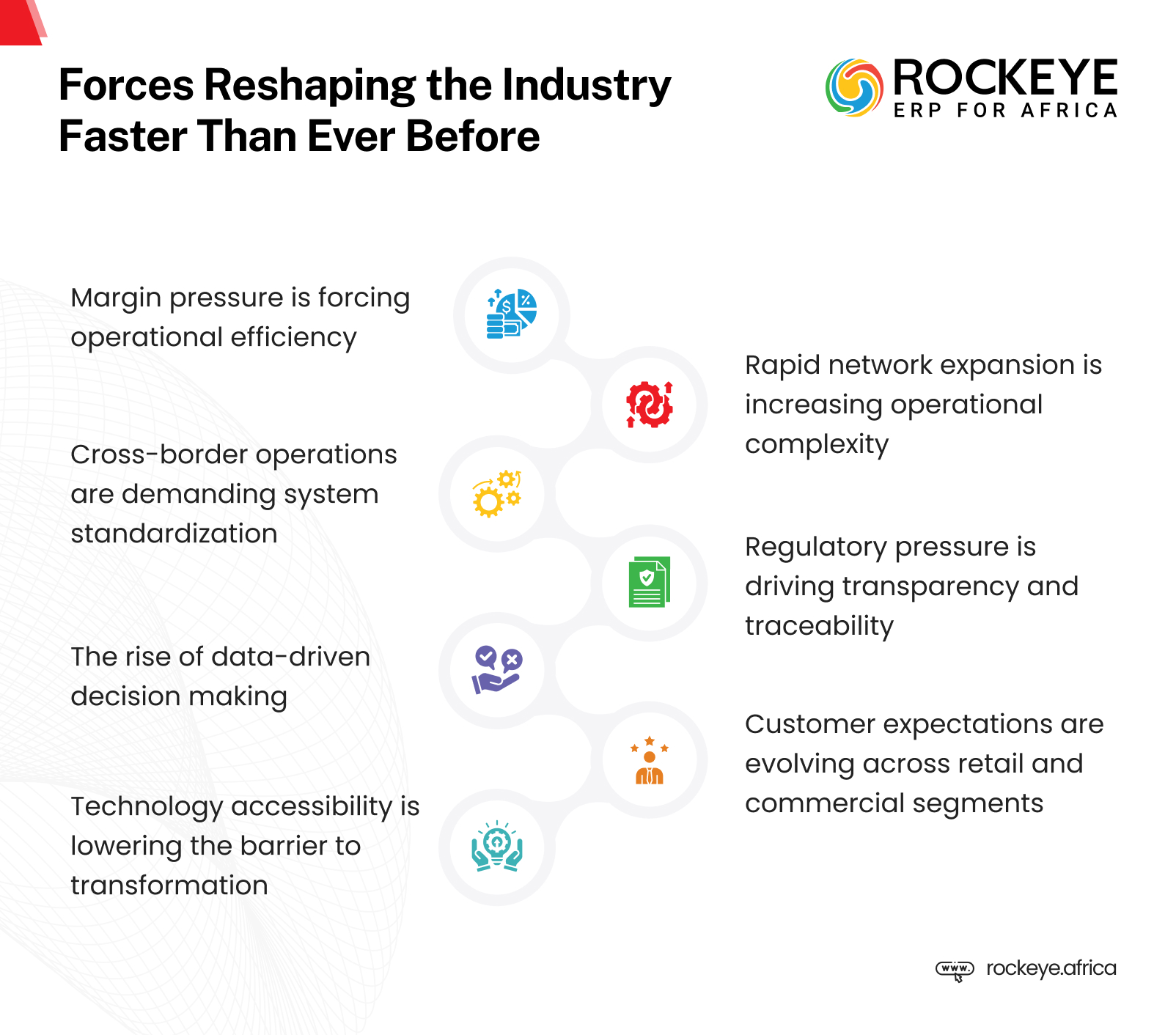
1. Margin Pressure is Forcing Operational Efficiency
Downstream oil and gas has always been a margin-sensitive business, but the pressure is intensifying.
Fluctuating global prices, currency volatility, and rising operational costs are compressing margins across African markets. In this environment, even small inefficiencies in procurement, transport, or inventory management can have outsized financial impact.
Industry estimates show that inefficient downstream operations can increase total operating costs by 20–25%, directly affecting profitability.
As a result, companies are turning to digital systems to:
- Optimize procurement pricing
- Reduce transport inefficiencies
- Improve stock accuracy
Efficiency is no longer a competitive advantage but a baseline requirement for survival.
2. Rapid Network Expansion is Increasing Operational Complexity
Across Africa, oil marketing companies are scaling aggressively with expanding retail networks, increasing depot capacity, and entering new markets.
However, growth introduces complexity.
Each additional station, depot, or transport route increases the volume of transactions, data, and coordination required. Without centralized systems, this complexity becomes difficult to manage.
Organizations that scale without digital infrastructure often experience:
- Up to 35% increase in coordination delays
- Reduced visibility across locations
- Inconsistent operational standards
Digital platforms are now essential to ensure that growth does not compromise control.
3. Cross-Border Operations Are Demanding System Standardization
Many African oil and gas companies operate across multiple countries, each with:
- Different currencies
- Distinct tax structures
- Unique regulatory requirements
Managing this complexity manually or through disconnected systems creates significant risk.
Without standardized systems:
- Financial reporting becomes inconsistent
- Compliance processes become fragmented
- Operational visibility is reduced
Digital transformation enables organizations to operate across borders with:
- Unified processes
- Real-time financial alignment
- Standardized reporting frameworks
4. Regulatory Pressure is Driving Transparency and Traceability
Governments and regulatory bodies across Africa are increasing their focus on:
- Tax accuracy
- Import/export documentation
- Fuel movement tracking
- Audit transparency
Non-compliance is becoming more costly and not just financially, but reputationally.
Manual compliance processes are no longer sustainable in this environment. Errors in documentation, delays in reporting, or inconsistencies in data can lead to penalties and operational disruptions.
Digital systems embed compliance directly into workflows, ensuring that:
- Every transaction is traceable
- Every document is accessible
- Every process is audit-ready
Compliance is shifting from a reactive function to a system-driven capability.
5. The Rise of Data-Driven Decision Making
In Africa, this shift is gaining momentum.Oil and gas companies are leveraging data to improve everything from supply chain efficiency to pricing strategies.
Organizations are increasingly recognizing that:
- Delayed data leads to delayed decisions
- Incomplete data leads to inaccurate decisions
Companies with real-time data capabilities can improve decision-making speed by up to 40%, enabling them to respond faster to market changes, operational issues, and customer demand.
Data is becoming the foundation of operational strategy.
6. Customer Expectations Are Evolving Across Retail and Commercial Segments
End customers whether retail consumers, aviation clients, or industrial buyers are demanding higher levels of reliability,transparency & speed.
Retail customers expect consistent pricing and service across stations. Commercial clients expect accurate billing, timely deliveries, and clear visibility into transactions.
Without digital systems:
- Service inconsistencies increase
- Customer trust erodes
- Operational inefficiencies become visible externally
Digital transformation enables organizations to deliver a more consistent and reliable customer experience, which is increasingly becoming a differentiator.
7. Technology Accessibility is Lowering the Barrier to Transformation
Perhaps one of the most significant enablers of digital transformation in Africa is the increasing accessibility of technology.
Cloud infrastructure, mobile platforms, IoT devices, and API-driven systems are making it easier and more cost-effective to implement advanced solutions.
Compared to a decade ago:
- Implementation timelines have reduced by up to 30–50%
- Infrastructure costs have decreased significantly
- System scalability has improved dramatically
This shift allows African operators to leapfrog traditional limitations, moving directly into modern, integrated digital environments.
A Convergence That Makes Transformation Inevitable
What makes this moment unique is not any single driver but the combination of all of them.
Operational pressure, growth, regulation, data, and technology are converging to create a landscape where transformation is no longer optional.
Organizations that respond to these forces with connected, system-driven strategies will position themselves for efficiency, scalability, and long-term competitiveness.
Those that don’t will find themselves constrained by complexity that continues to grow—but becomes increasingly difficult to control.
From Disconnected Efforts to a Unified Operational Core
As digital transformation accelerates across Africa’s oil and gas sector, one reality is becoming increasingly clear:
Transformation cannot be sustained through isolated systems.
While individual tools may optimize specific functions, they do not solve the core challenge of downstream operations which is coordination across an interconnected value chain.
This is where ERP systems are redefining their role.
No longer limited to back-office functions, ERP platforms are evolving into the central operational backbone, connecting processes, data, and decisions across the entire business.
1. ERP Creates a Single Source of Truth Across the Organization
One of the most critical challenges in downstream operations is inconsistent data.
When procurement, inventory, sales, and finance operate on separate systems, discrepancies become inevitable. Reports conflict, reconciliation becomes time-consuming, and decision-making slows down.
ERP systems address this by centralizing data into a unified environment.
Organizations that implement integrated ERP platforms can improve data consistency by up to 60–70%, significantly reducing reconciliation efforts and increasing confidence in decision-making.
A single, reliable version of the truth becomes the foundation for all operations.
2. ERP Enables End-to-End Process Visibility
Downstream oil and gas operations are inherently interconnected. A procurement decision affects terminal intake. Terminal operations influence inventory. Inventory impacts sales and distribution.
Without visibility across this chain, inefficiencies remain hidden.
ERP systems provide end-to-end visibility, allowing organizations to track processes from initiation to completion within one platform.
This level of transparency can improve operational visibility by over 45%, enabling faster identification of bottlenecks, discrepancies, and inefficiencies.
3. ERP Standardizes Processes Across Complex Operations
In multi-location, multi-entity environments, inconsistency is a major risk.
Different locations may follow different processes, leading to:
- Variations in data quality
- Operational inefficiencies
- Compliance risks
ERP systems enforce standardized workflows across the organization.
This standardization can reduce process variability by up to 50%, ensuring that operations are executed consistently regardless of location or scale.
4. ERP Accelerates Decision-Making Through Real-Time Data
Delayed data leads to delayed decisions.
In traditional environments, reporting cycles can take hours or even days before actionable insights are available. This lag reduces responsiveness in a fast-moving operational landscape.
ERP systems enable real-time data access, allowing decision-makers to act immediately.
Organizations leveraging real-time ERP capabilities can reduce decision cycle times by up to 40%, improving agility across procurement, logistics, and sales.
5. ERP Strengthens Compliance and Audit Readiness
Compliance in oil and gas is complex and continuous.
Manual processes often result in:
- Missing documentation
- Inconsistent records
- Audit delays
ERP systems embed compliance into operational workflows, ensuring that:
- Every transaction is recorded
- Every document is linked
- Every process is traceable
This can improve audit accuracy by over 30% and significantly reduce regulatory risk.
6. ERP Provides the Foundation for Scalable Growth
As organizations expand, complexity increases.
More locations, higher transaction volumes, and broader operational scope require systems that can scale without losing efficiency.
ERP platforms are designed to handle this growth by:
- Supporting multi-entity operations
- Managing multi-currency transactions
- Handling large data volumes without performance loss
Organizations with scalable ERP systems can manage growth with up to 35–50% greater operational efficiency, compared to those relying on fragmented systems.
The Shift from Systems to Infrastructure
ERP is no longer just a system you implement, it is an infrastructure you build your operations on.
It connects what was previously disconnected, aligns what was previously fragmented and enables what was previously difficult to control.
In the context of Africa’s oil and gas sector, where complexity is increasing and transformation is accelerating, ERP is the foundation that makes transformation possible.
From Generic Systems to Industry-Engineered Execution
As ERP adoption grows across Africa’s oil and gas sector, a new challenge is emerging.
Not all ERP systems are built for the realities of downstream operations.
Many platforms provide general functionality; finance, procurement, inventory; but struggle to handle the depth, speed, and interconnected complexity of oil and gas environments. As a result, organizations often find themselves adapting their operations to fit the system, rather than the system supporting how they actually operate.
This is where ROCKEYE fundamentally differs.
It is not an ERP adapted to the industry.
It is a platform engineered around the industry itself.
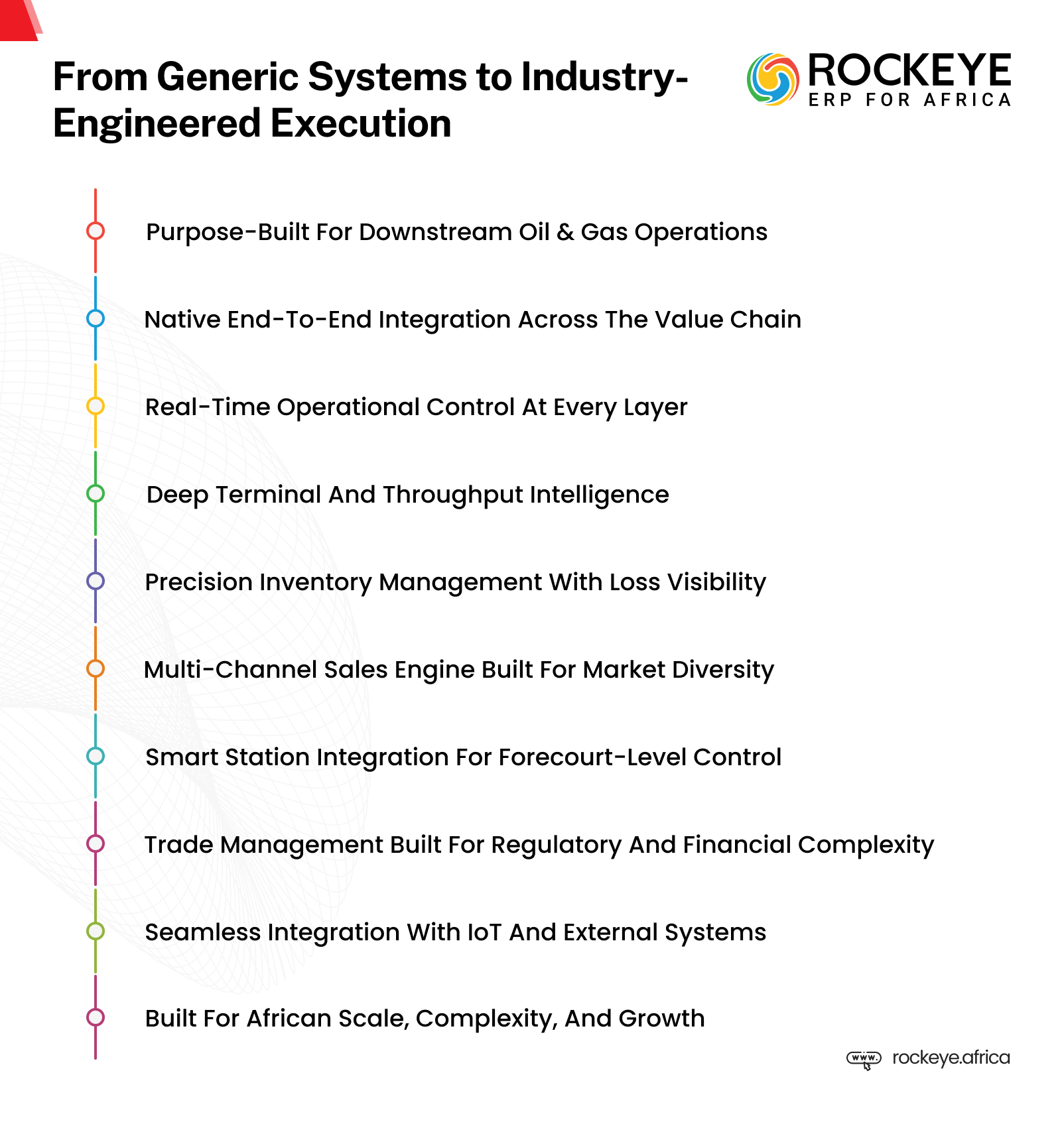
1. Purpose-Built for Downstream Oil & Gas Operations
ROCKEYE ERP for oil and gas companies is designed specifically for downstream workflows from terminal intake and throughput to retail distribution and trade.
This industry alignment reduces implementation friction by up to 40%, as processes do not need to be re-engineered to fit a generic system.
Organizations adopt faster and operate more naturally within the platform.
2. Native End-to-End Integration Across the Value Chain
Unlike traditional ERPs that rely on integrations between separate modules, ROCKEYE operates as a continuous, unified system.
Procurement software, terminal operations management system, inventory management software, sales management system, and trade management system are inherently connected.
This eliminates data handoff delays and can improve cross-functional data flow efficiency by over 60%, ensuring that every action in one area is instantly reflected across the system.
3. Real-Time Operational Control at Every Layer
ROCKEYE is built on live data architecture, where every transaction, stock movement, and operational activity is captured and reflected instantly.
This enables organizations to achieve near 100% real-time visibility across operations, significantly reducing response times and improving decision accuracy.
4. Deep Terminal and Throughput Intelligence
Where many ERPs stop at inventory and finance, ROCKEYE goes deeper into terminal-level operations.
It supports:
- Throughput management
- Vessel scheduling and discharge tracking
- Jetty, gantry, and pipeline coordination
- Outturn and contract-based billing
This level of specialization can improve terminal utilization efficiency by up to 25–30%, while ensuring accurate revenue capture from throughput activities.
5. Precision Inventory Management with Loss Visibility
ROCKEYE connects tank-level data, stock movements, and reconciliation processes into a single system.
With real-time tracking and automated variance detection, organizations can reduce product losses by up to 80–90%, while significantly improving stock accuracy across depots and stations.
6. Multi-Channel Sales Engine Built for Market Diversity
African downstream markets are not uniform, they span retail, aviation, and commercial/industrial segments.
ROCKEYE is designed to handle this diversity within a single platform, enabling organizations to manage:
- High-volume retail station networks
- Aviation fueling operations with strict compliance
- Bulk distribution to industrial clients
This unified approach can improve sales process efficiency by up to 35–45%, while maintaining consistency across channels.
7. Smart Station Integration for Forecourt-Level Control
ROCKEYE extends beyond enterprise systems into the forecourt.
By integrating directly with:Fuel dispensers, Forecourt controllers, Automatic tank gauging systems it ensures that every litre dispensed is captured in real time.
This reduces manual dependency and can improve station-level reconciliation accuracy by over 90%, significantly minimizing leakages and discrepancies.
8. Trade Management Built for Regulatory and Financial Complexity
Trade operations in Africa involve complex documentation, compliance requirements, and financial tracking.
ROCKEYE incorporates:
- Bond and ledger management
- Customs documentation workflows
- Platts-based pricing integration
- Entry/exit compliance tracking
This enables organizations to reduce compliance-related errors by up to 30–40%, while improving financial transparency across trade activities.
9. Seamless Integration with IoT and External Systems
ROCKEYE is designed to bridge physical operations with digital systems through:
- IoT device integration (ATG, sensors, controllers)
- Transport and VTS tracking
- API-driven third-party integrations
This creates a fully connected ecosystem where real-world operations are reflected instantly in the system, eliminating blind spots and improving operational accuracy.
10. Built for African Scale, Complexity, and Growth
Perhaps most importantly, ROCKEYE is designed with the realities of African operations in mind.
It supports:
- Multi-company and multi-country operations
- Multi-currency environments
- High transaction volumes across distributed networks
Organizations can scale operations while maintaining control, achieving up to 35–50% improvement in operational efficiency at scale.
A System That Aligns with How the Industry Actually Works
What sets ROCKEYE apart is not just functionality, it is alignment.
It aligns with:
- How fuel moves
- How operations are executed
- How decisions are made
Instead of forcing businesses to adapt to software, it enables software to adapt to the business.
From Momentum to Mastery: Defining Africa’s Digital Oil & Gas Future
Africa’s oil and gas sector is no longer in the early stages of digital transformation, it is in the middle of it.
Progress is visible across the industry. Systems are being introduced, processes are evolving, and organizations are beginning to recognize the value of data and automation. But as this shift accelerates, a clear divide is emerging between digital activity and true transformation.
The difference lies in execution.
Adopting tools is no longer enough. Running isolated systems is no longer sustainable. As operations grow more complex and expectations continue to rise, the ability to connect, align, and operate in real time is becoming the defining factor of performance.
This is where the future of the industry will be decided.
Organizations that move beyond fragmented digital efforts and build fully integrated operational environments will gain more than efficiency. They will gain control over inventory, over costs, over compliance, and ultimately, over decision-making.
Those that do not will find themselves managing increasing complexity with tools that were never designed to handle it.
And in this environment, ROCKEYE is enabling a new way of operating. By unifying the entire downstream value chain into a single, real-time system, ROCKEYE allows businesses to move from reactive execution to proactive, intelligence-driven operations.
The opportunity in Africa is unique. Without the weight of deeply entrenched legacy systems in many markets, organizations have the ability to leap forward, adopting connected, modern platforms that redefine how operations are run.
The advantage will not go to those who digitize first.
It will go to those who digitize right, with systems that bring clarity, control, and scalability into every layer of the business.