


ERP Implementation Roadmap for African Oil Companies (Step-by-Step)

Why African downstream needs a tailored ERP roadmap
Implementing ERP for downstream oil and gas in Africa is different from other industries or regions. Operators face unique challenges: multi-location networks spanning terminals, depots, transporters, and retail stations; inconsistent connectivity; mixed cash and digital payments; complex regulations; and the need to minimize disruption to 24/7 operations. A generic ERP rollout risks failure, cost overruns, and operational chaos.
ROCKEYE is a cloud-based ERP designed specifically for African downstream oil and gas operations, covering the full value chain from terminal automation (TAS), fluid inventory management, and trade operations to smart station management, sales and distribution (SD), logistics, vehicle tracking, finance, procurement, HRMS, and asset management. The platform is built for sector realities such as distributed multi-location operations, intermittent connectivity, offline-capable workflows, mobile accessibility, and regulatory complexity. The implementation roadmap below follows a practical, phased approach focused on early operational wins while progressively building toward full enterprise integration.
Phase 1: Assess and plan (4–8 weeks)
Start with a focused assessment to map your current operations against ERP capabilities, prioritizing the modules that address your biggest pain points. Engage cross-functional teams from operations, finance, IT, and end-users (station managers, transporters, depot staff) to document key processes: terminal receipt and lifting, depot-to-station supply, station sales, transport payouts, and financial close.
Identify 2–3 high-impact modules to pilot, such as TAS for terminal operations or Smart Station for retail visibility, based on your business model (e.g., depot-focused vs. retail-heavy). Define success metrics like reduced reconciliation time, stock accuracy, or margin visibility. ROCKEYE’s team supports a discovery workshop to align on scope, timeline, and data migration needs, ensuring the plan fits African constraints like variable power and bandwidth. Output: Signed project charter, prioritized modules, and resource plan.
Phase 2: Pilot and quick wins (8–12 weeks)
Begin with a controlled pilot using either a single site or a focused operational module to minimize risk while validating real-world performance. For operators prioritizing terminal efficiency, start with Terminal Automation (TAS), focusing on terminal management functions such as automated product disbursement through gantry systems using loading ticket (LT) processes, tank integration, and operational visibility.
In parallel, trade-related activities—covering throughput transactions, commercial movements, and stock ownership tracking—can be configured to ensure alignment between operational flows and commercial records. Train a small user group (5–10 people) and run parallel operations for 2–4 weeks to validate data accuracy, operational continuity, and user adoption before scaling further.
ROCKEYE’s cloud deployment allows rapid setup without heavy hardware investment, and mobile apps enable on-site access for terminal staff. Go live with the pilot module, monitor KPIs daily, and iterate based on feedback. This phase delivers immediate value—like faster lifting approvals or automated terminal reports—while building internal confidence and change management momentum. Success metric: 80%+ user adoption and measurable process time savings.
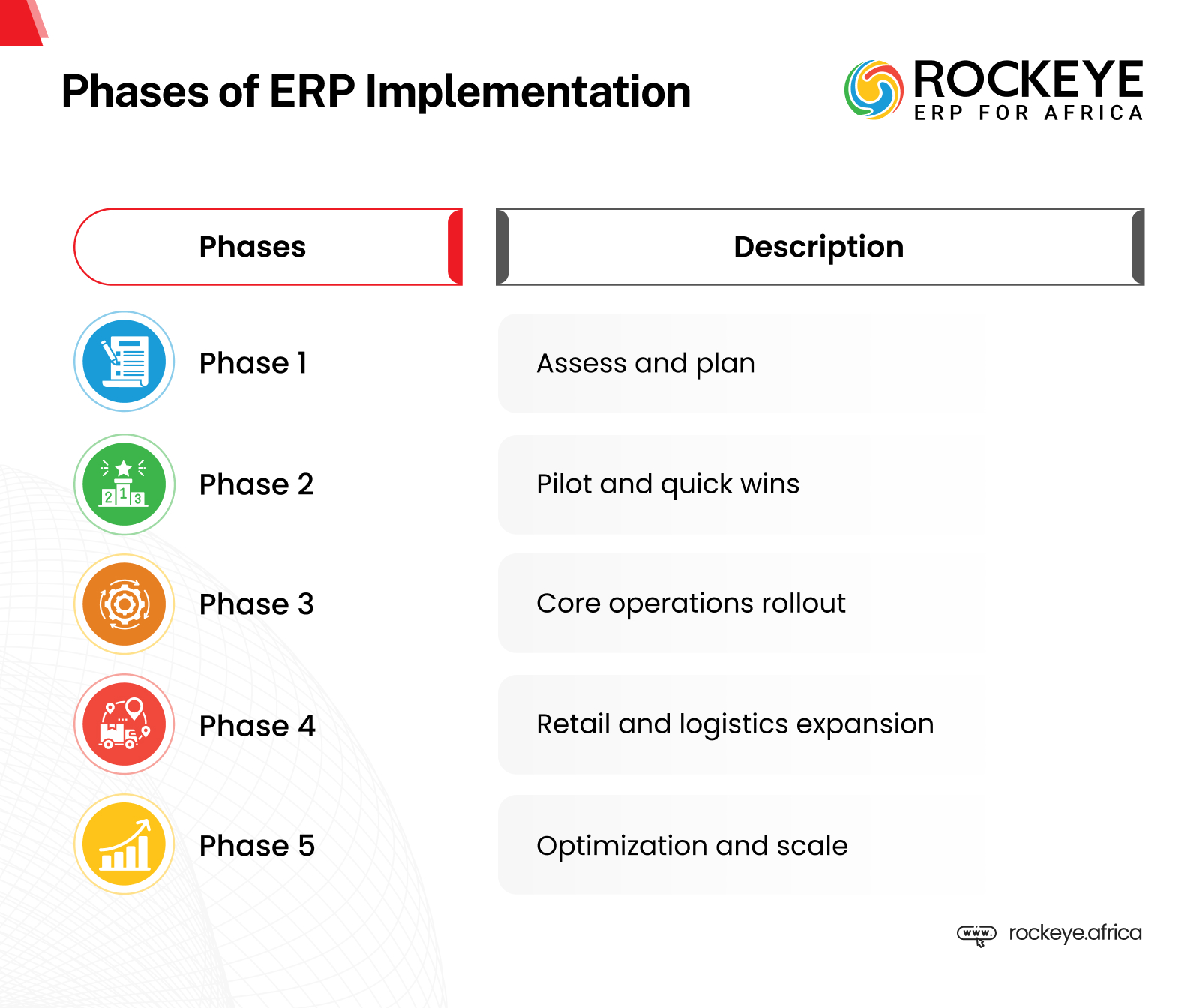
Phase 3: Core operations rollout (12–20 weeks)
Expand to 2–3 interconnected modules and 5–10 key locations, focusing on end-to-end flows like terminal-to-depot supply or depot-to-station distribution. Integrate TAS with Inventory Management and Smart Logistics for automated stock transfers and transporter dispatch; add Finance for real-time posting of liftings and sales.
Conduct site-specific configurations for local pricing, taxes, and workflows, leveraging ROCKEYE’s multi-currency and regulatory alignments. Roll out training in waves (online modules + hands-on sessions), and use ROCKEYE’s offline sync for stations with poor connectivity. Migrate historical data in batches, running parallel for 4 weeks per site. Monitor with daily standups and weekly steering meetings. Output: Live operations across core network with unified visibility.
Phase 4: Retail and logistics expansion (16–24 weeks)
Scale to full retail network and transporter fleet management software, deploying Fuel Station Management Software for IoT-enabled forecourt monitoring and Vehicle Tracking for real-time fleet governance. Connect these to upstream modules for continuous visibility from terminal receipt to nozzle sales. Implement Oil Gas Procurement Software for supplier onboarding and HRMS for staff rostering and payouts tied to verified performance.
Phased site go-lives (e.g., 20 stations per wave) with hypercare support ensure smooth adoption. ROCKEYE’s white-label mobile apps allow branded access for station attendants and drivers, reducing resistance. Automate exception workflows, like low-stock alerts or route deviations, to drive daily usage. At this stage, leverage built-in analytics for network-wide insights on margins, leakages, and efficiency.
Phase 5: Optimization and scale (Ongoing, starting week 24+)
With the system live, focus on continuous improvement: activate advanced analytics, AI-driven forecasting, and RPA for reconciliations across TAS, trade, inventory, finance, and logistics. Train super-users as internal champions and establish a Center of Excellence for new features or expansions (e.g., new depots or countries).
ROCKEYE provides quarterly health checks, performance tuning, and upgrades via cloud without downtime. Measure ROI through KPIs like 20–30% reduction in stock variances, 50% faster month-end close, or 15% logistics savings. Plan for annual reviews to incorporate emerging needs like enhanced compliance or ESG reporting.
Keys to success in African downstream ERP projects
This roadmap succeeds because it is incremental, business-led, and tailored to downstream realities: start small for quick ROI, prioritize user training and mobile/offline access, and ensure modules interconnect seamlessly. Total timeline: 6–12 months to full rollout, depending on network size, with benefits accruing from day one of the pilot.
ROCKEYE’s sector-specific design—cloud-native, IoT-ready, and Africa-proven—reduces customization needs and implementation risks compared to generic ERPs. Downstream leaders who follow a structured, phased approach like this will achieve the operational control, visibility, and efficiency needed to thrive in 2026 and beyond, turning ERP into a competitive advantage rather than an IT burden.